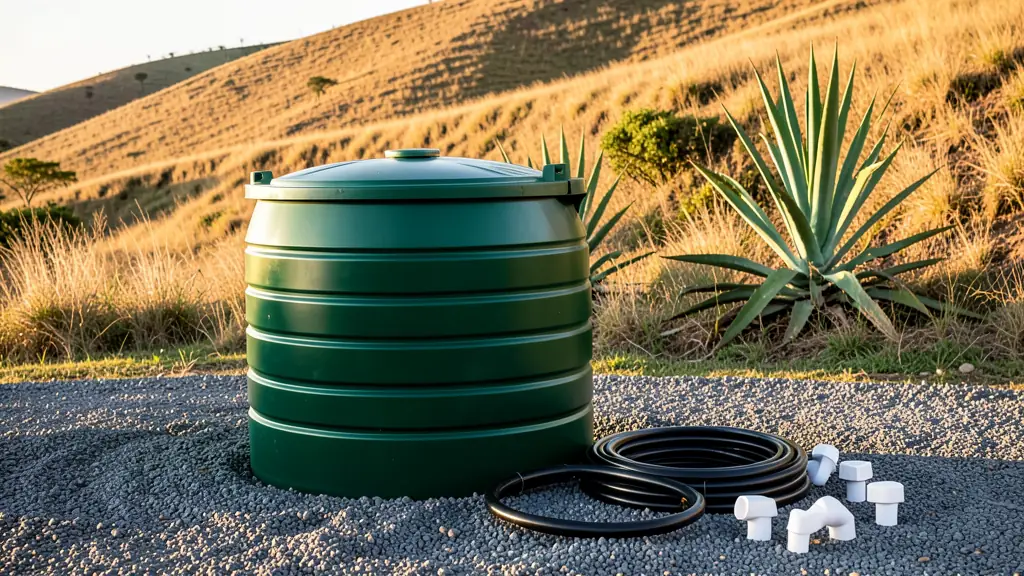
Knowing how many litres a tank holds is the first step in quoting a pump-out, choosing a replacement or checking a septic or conservancy tank against the size the council asked for. Tanks come in boxes, upright drums and lying cylinders, and each needs a different formula. This calculator does the sums from the inside measurements, shows how much liquid is in the tank now and works out how many honey sucker loads it will take to empty.
The formulas, shape by shape
Measure the inside of the tank, not the outside, since walls and ribs take up space. One cubic metre is 1,000 litres, so work in metres and multiply by 1,000.
Rectangular: litres = length × width × depth × 1,000
e.g. 2 × 1.5 × 1 × 1,000 = 3,000 L
Upright round: litres = π × r² × height × 1,000
e.g. 1.8 m across, 1.5 m high: π × 0.9² × 1.5 × 1,000 = 3,817 L
Lying cylinder: litres = π × r² × length × 1,000
e.g. 1.2 m across, 2.5 m long: π × 0.6² × 2.5 × 1,000 = 2,827 L
For an upright tank, the liquid is simply the same formula with the liquid depth in place of the height.
Partly filled lying cylinders
A tank on its side holds liquid in the shape of a circular segment, so half the depth is not half the volume. With radius r and liquid depth h, the area of the liquid at the end of the tank is:
A = r² × acos((r − h) ÷ r) − (r − h) × √(2rh − h²)
Liquid (L) = A × length × 1,000
A tank 1.2 m across (r = 0.6) filled to 0.3 m has a segment area of 0.2211 m². Over 2.5 m of length that is about 553 litres, only 20% of the full 2,827 litres, even though the liquid is a quarter of the diameter deep. Use the dipstick reading from the bottom of the tank and the calculator does the rest.
Common tank sizes and tanker loads
| Tank size | Honey sucker loads at 10 kL |
|---|---|
| 1,500 L | 1 |
| 2,500 L | 1 |
| 5,000 L | 1 |
| 10,000 L | 1 |
| 15,000 L | 2 |
| 25,000 L | 3 |
Honey suckers carry roughly 5 kL on a small truck or trailer up to 16 kL on a big tanker, so 10 kL is the planning figure. Most home septic and conservancy tanks fit in one load. See honey sucker services for what an operator needs from you, and conservancy tank emptying for sealed tanks, which are often charged per load.
Using the answer
- Checking the tank. Compare the volume with the minimum from the septic tank size calculator. A tank that is too small fills with sludge and fails early.
- Buying a replacement. The nearest common size is shown, but the real size is the manufacturer's rating. See plastic septic tanks and concrete septic tanks.
- Planning a pump-out. Enter the liquid depth if the tank is part full, or leave it blank to cost a full tank. The conservancy tank calculator shows how often a sealed tank fills.
Measurements taken from a tank through a small lid are rarely exact, so treat the result as a planning figure and expect the operator to confirm on site.