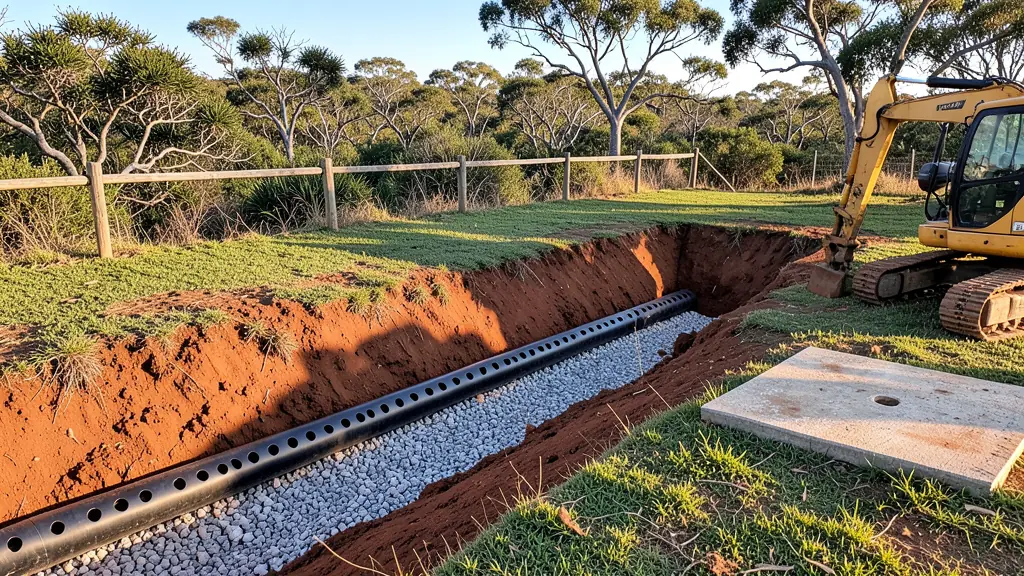
The tank is only half of a septic system. The water that leaves it still has to soak into the ground, and the pipes and gravel that do this are the septic tank drainage field. When that field clogs, the whole system backs up even if the tank was pumped last month. Tell us about your symptoms and where you are, and drainage contractors near you will quote to diagnose and repair the field.
How a drainage field fails
Liquid leaves the tank through an outlet tee and flows along perforated pipes in gravel trenches. Over the years a dark, sticky layer called a biomat forms where the gravel meets the soil. It is normal in small amounts, but it becomes a seal when solids escape from a full tank, when fat gets through or when the system is overloaded with water. Tree roots, crushed pipes, compacted soil from vehicles and a high water table all make it worse.
Warning signs and how it is diagnosed
- Soggy, bright green grass or standing water over the drainage area.
- A sewage smell outdoors, especially after rain.
- Slow drains and gurgling toilets even after the tank is emptied.
- Effluent surfacing, or a tank that refills within days of a pump-out.
The contractor starts by checking the tank level and the outlet tee, then probes the field and opens inspection points. A distribution box that has settled can send all the flow into one trench, and a camera can inspect pipes. If the tank has not been cleaned recently, book septic tank cleaning first, because the diagnosis is easier and the field may recover.
Repair options
The right fix depends on what the investigation finds:
- Rest and clean: reduce water use and pump the tank, which sometimes lets a mildly clogged field recover.
- Jet or replace damaged pipes: clear silt from the lines, or dig up crushed and root-filled sections.
- Rebuild a trench or two: remove clogged gravel and lay fresh stone and pipe. See french drains.
- Build a new field or pit: where the old one is beyond repair, a fresh soakaway is often the answer.
Keep vehicles, paving and trees off the new field. Whatever is chosen, ask the contractor to explain why the field failed, because repairs that ignore the cause tend to fail again within a few years.
What affects the price
Cost depends on how much of the field must be dug up, the soil, how easily a small excavator reaches the area, and how much stone and pipe is needed. A diagnosis and pipe jetting is a modest job. A completely new field is a larger one, and some municipalities want plans approved before work starts. Ask for the scope in writing, including who disposes of the old gravel and whether the lawn will be reinstated afterwards. Quotes that look cheap often leave out machine hire, stone or reinstatement.
What to include in your request
- Symptoms you see: wet ground, smell, slow drains or surfacing water
- Tank size and when it was last pumped
- Roughly where the drainage field or soakaway is on the plot
- Soil type, slope and whether the area floods in rain
- Whether trees, paving or vehicles are near the field
Septic Tank Drainage for different properties
- Houses: diagnosing a wet lawn and slow drains at an older house on a septic tank
- Smallholdings and plots: repairing or enlarging a field on a smallholding where the soil is heavy or the water table high
- Estates and complexes: inspecting shared fields for a complex, with a written report for the body corporate
- Farms and game farms: repairing fields at homesteads and worker housing, often alongside a new pit
- Lodges, guesthouses and venues: rebuilding fields overloaded by guest numbers, ideally outside the busy season
- Restaurants, shops and offices: diagnosing fields at shops, restaurants and filling stations where trading must continue
- Schools, churches and clinics: assessing large fields at schools, churches and clinics before a long holiday
- Factories, mines, sites and events: inspecting and rebuilding drainage for site offices, depots and factory ablutions
Frequently asked questions
How much does it cost to repair septic tank drainage?
How long does a drainage field last?
Can I use chemicals to unclog a drainage field?
Does heavy rain affect septic drainage?
Septic Tank Drainage by province and city
- Johannesburg
- Pretoria
- Centurion
- Midrand
- Sandton
- Randburg
- Roodepoort
- Krugersdorp
- Randfontein
- Germiston
- Boksburg
- Benoni
- Kempton Park
- Alberton
- Vanderbijlpark
- Vereeniging
- Durban
- Pinetown
- Pietermaritzburg
- Richards Bay
- Newcastle
- Ladysmith
- Gqeberha (Port Elizabeth)
- East London
- Kariega (Uitenhage)
- Mthatha
- Cape Town
- Bellville
- Paarl
- Stellenbosch
- George
- Worcester
- eMalahleni (Witbank)
- Middelburg
- Secunda
- Mbombela (Nelspruit)
- Rustenburg
- Brits
- Klerksdorp
- Potchefstroom
- Mahikeng
- Polokwane
- Tzaneen
- Kimberley
- Upington
- Bloemfontein
- Welkom
- Sasolburg