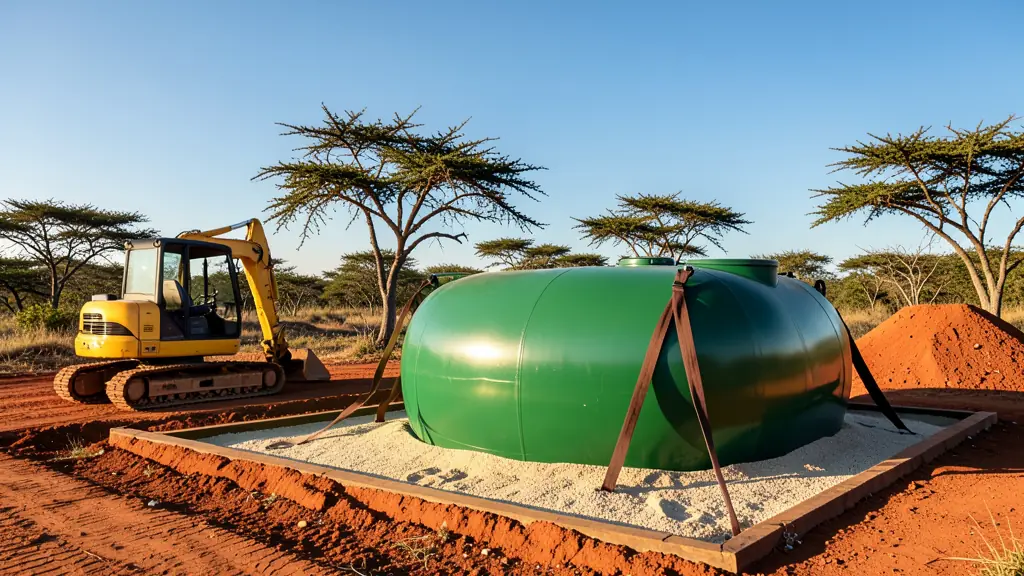
Plastic septic tanks are moulded from polyethylene in one piece, with no joins to leak. They are far lighter than concrete, so a small crew can set one in the ground in a morning. That makes them the most common choice for new houses, cottages and lodges across South Africa. Tell us the size you need and where the tank must go, and suppliers who deliver to your area quote you directly, with or without installation.
How a polyethylene tank is made
Most local tanks are rotomoulded: plastic powder is heated in a spinning mould until it coats the inside evenly, which gives a seamless tank with a thick, uniform shell. Ribs on the outside add strength against soil pressure. Well-known makers such as Rototank sell ranges of buried tanks in this way, and several regional makers do the same. Inlet and outlet sockets are fitted to suit 110 mm pipe, and a lid with a manhole collar sits on top.
Check that the tank is rated for burial. A tank made for storing water above ground is not built to take soil load.
Sizes and what they suit
Plastic tanks are sold from about 1,000 litres up to 10,000 litres, and larger sites simply use two or three in a row. Rough guides:
- 2,500 litres: a small house with up to four people.
- 5,000 litres: a family home or a small guesthouse.
- 10,000 litres: a lodge, school hostel or staff housing.
A single tank is often a one-chamber unit, so many installers add a second tank in series for better settling. See septic tank design before you choose, and JoJo septic tanks for one popular brand.
Installing in wet or unstable ground
A buried plastic tank is light, and an empty one can float when the water table is high. In clay, near a river or on the coast, the hole must be dewatered, the tank sat on a level sand bed and backfilled in layers with sand while the tank is filled with water. Many installers also strap the tank to a concrete base slab. Skipping these steps is the main reason plastic tanks lift or tilt.
The outlet must still run to a soakaway or french drain sized for the soil. For the full process, read septic tank installation.
Pros, cons and cost
Plastic is quick to install, will not crack from soil movement and does not corrode. Against that, it can be dented by heavy vehicles, so keep traffic off the tank area, and it needs careful backfilling. Expect roughly R6,500 to R16,000 for a 2,500 to 5,000 litre tank before delivery and installation. Prices vary by region and fluctuate with polymer costs, so compare current quotes. More in septic tank prices.
Also ask about the warranty, the shell thickness quoted by the maker, and whether the lid is lockable and UV-stabilised. A cheap tank with a thin shell and a flimsy lid costs more in the end, because repairs mean digging up the whole installation.
What to include in your request
- Tank size in litres, or the number of people and bedrooms
- Delivery address and how close a truck can get to the hole
- Soil type and whether the water table is high
- Whether you want supply only or supply and installation
- Municipal approval status and the drainage plan, if any
Plastic Septic Tanks for different properties
- Houses: a 2,500 to 5,000 litre buried tank for a new or renovated off-sewer house
- Smallholdings and plots: a light tank that one truck can deliver to a remote building site
- Estates and complexes: a row of plastic tanks serving a few cottages or units on shared ground
- Farms and game farms: tanks for worker housing and farmstalls, often delivered a long way from town
- Lodges, guesthouses and venues: larger tanks in series for chalets, with anchoring where the ground is damp
- Restaurants, shops and offices: small tanks behind a shop, restaurant or filling station, with a grease trap upstream
- Schools, churches and clinics: tanks for a rural school or clinic where installation must be quick
- Factories, mines, sites and events: tanks for site offices and ablutions on construction sites and small works
Frequently asked questions
Are plastic septic tanks better than concrete?
How long does a plastic septic tank last?
Can a plastic tank float out of the ground?
Do I need plans approved before installing one?
Plastic Septic Tanks by province and city
- Johannesburg
- Pretoria
- Centurion
- Midrand
- Sandton
- Randburg
- Roodepoort
- Krugersdorp
- Randfontein
- Germiston
- Boksburg
- Benoni
- Kempton Park
- Alberton
- Vanderbijlpark
- Vereeniging
- Durban
- Pinetown
- Pietermaritzburg
- Richards Bay
- Newcastle
- Ladysmith
- Gqeberha (Port Elizabeth)
- East London
- Kariega (Uitenhage)
- Mthatha
- Cape Town
- Bellville
- Paarl
- Stellenbosch
- George
- Worcester
- eMalahleni (Witbank)
- Middelburg
- Secunda
- Mbombela (Nelspruit)
- Rustenburg
- Brits
- Klerksdorp
- Potchefstroom
- Mahikeng
- Polokwane
- Tzaneen
- Kimberley
- Upington
- Bloemfontein
- Welkom
- Sasolburg