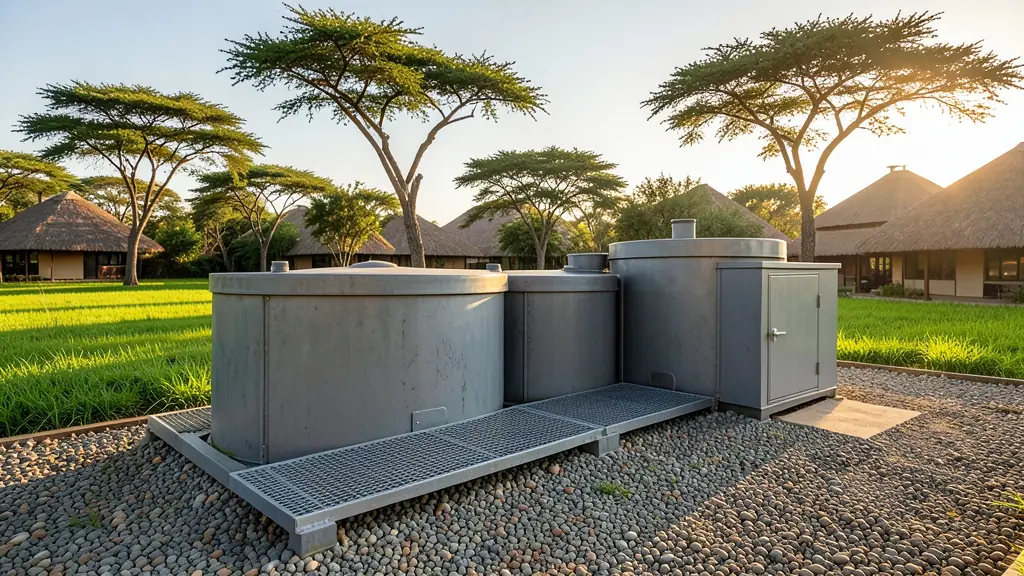
A sewage treatment plant cleans wastewater to a standard that can be reused or released, which a septic tank alone cannot do. Package plants arrive as ready-made units and suit places with no sewer connection and too much flow for a soakaway: estates, lodges, schools, clinics, mines and large farms. Tell us the daily flow and where the treated water will go, and suppliers and installers in your area will quote you directly.
How a package plant works
Raw sewage first passes through a screen or settling tank that removes solids. It then enters an aeration stage, where blowers push air through the water so bacteria can break down the organic matter. Two common designs are activated sludge, in which the bacteria float freely and settle out afterwards, and MBBR (moving bed biofilm reactor), in which the bacteria grow on small plastic carriers that tumble in the tank. A final stage clarifies and disinfects the water, usually with chlorine, before discharge or reuse.
Who uses them and how big they are
Package plants are rated by daily flow in kilolitres, from around 5 kilolitres for a small lodge to several hundred for a mine camp or town. Typical users include housing estates beyond the municipal network, game lodges, schools, clinics, filling stations and construction camps. The plant is built in a steel, fibreglass or concrete tank and installed above or below ground. Small houses are better served by a septic tank or a biodigester.
Reusing treated effluent
Treated water can be used to irrigate lawns, sports fields, gardens and some crops, but only where the quality meets the limits in your authorisation. Irrigation lines are usually fed by a holding dam or tank and a pump, with sprayers placed away from boreholes and public areas. Reuse saves municipal water on dry sites, which is why lodges and estates in dry regions often choose it. Never irrigate food crops eaten raw without advice from your supplier and the authorities.
Maintenance and compliance in general terms
A plant needs regular care: blowers checked, screens cleaned, sludge removed and the effluent tested. Many suppliers offer monthly service contracts. Sludge is collected by a honey sucker operator and taken to a licensed site. Larger plants usually need a water use authorisation and must meet discharge standards set by the national water authority, with sampling and records. Ask each supplier what approvals they handle, and what the yearly running cost will be, not just the purchase price.
Also ask who is responsible if the plant fails a sample, how fast a technician can reach you and whether spare blowers are kept in stock. On a remote lodge, a plant that stops for a week can close the whole kitchen.
What to include in your request
- Daily flow in kilolitres, or the number of users
- Where treated water will go: irrigation, dam or river
- Power supply on site, or a generator or solar
- Plant type preferred: activated sludge, MBBR or open
- Whether you need servicing and sampling after commissioning
Sewage Treatment Plants for different properties
- Houses: rarely used at a house; a septic tank or biodigester is normally enough
- Smallholdings and plots: a small plant for a large smallholding with several homes and heavy use
- Estates and complexes: a package plant for a whole estate, with treated water used on common gardens
- Farms and game farms: a plant for worker housing and a packhouse, with treated water for irrigation
- Lodges, guesthouses and venues: a plant sized for peak guest numbers, reusing water on lawns in dry regions
- Restaurants, shops and offices: a plant for a mall, hotel or filling station away from the sewer network
- Schools, churches and clinics: a plant for a boarding school, clinic or hospital with steady, large flows
- Factories, mines, sites and events: a plant for a mine camp or factory, with sampling and waste records
Frequently asked questions
How much does a sewage treatment plant cost?
What is the difference between a septic tank and a treatment plant?
Does a treatment plant need electricity?
Do I need a permit to run a treatment plant?
Sewage Treatment Plants by province and city
- Johannesburg
- Pretoria
- Centurion
- Midrand
- Sandton
- Randburg
- Roodepoort
- Krugersdorp
- Randfontein
- Germiston
- Boksburg
- Benoni
- Kempton Park
- Alberton
- Vanderbijlpark
- Vereeniging
- Durban
- Pinetown
- Pietermaritzburg
- Richards Bay
- Newcastle
- Ladysmith
- Gqeberha (Port Elizabeth)
- East London
- Kariega (Uitenhage)
- Mthatha
- Cape Town
- Bellville
- Paarl
- Stellenbosch
- George
- Worcester
- eMalahleni (Witbank)
- Middelburg
- Secunda
- Mbombela (Nelspruit)
- Rustenburg
- Brits
- Klerksdorp
- Potchefstroom
- Mahikeng
- Polokwane
- Tzaneen
- Kimberley
- Upington
- Bloemfontein
- Welkom
- Sasolburg