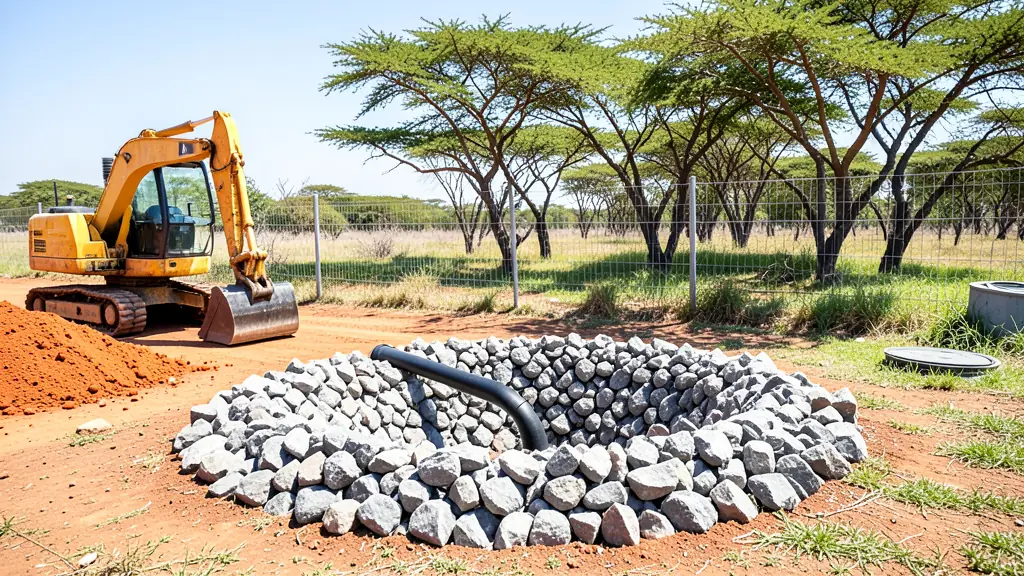
A septic tank only treats the water partway. The soakaway, also called a soak pit, takes what flows out and lets it sink into the ground. A septic tank and soakaway work as a pair, and if the soakaway is too small, blocked or built in the wrong place, the tank backs up. Tell us what you need and where you are, and contractors near you will quote to build, size or repair it.
How a soakaway works
Effluent flows from the tank outlet through a pipe into a pit. The pit is filled with stone or lined with a perforated chamber, so the water can spread out into the soil beneath and around it. Bacteria in the soil finish the treatment. A soakaway only works if the soil can accept the water, which is why it should sit well away from boreholes, streams and buildings, and the municipality or plan approver may set minimum distances.
Percolation tests and sizing
A percolation test measures how fast water drains from a test hole. The contractor digs a hole, fills it, and times how quickly the level falls. Fast drainage in sandy soil needs a small pit, while slow drainage in clay needs a much bigger one or a different design. The pit is sized for the number of people, the tank volume and the test result. A typical household soakaway is a pit about 2 to 3 metres across and 1.5 to 2.5 metres deep. A bigger family, or a lodge, needs more than one pit, and a high water table or shallow rock can rule out a deep pit altogether. Sizing should match the tank and the household, so see septic tank design.
Stone pits, rubble pits and chambers
There are three common ways to build one:
- Stone pit: filled with clean 38 to 75 mm stone and topped with geotextile and soil. Reliable and easy to repair.
- Rubble pit: built with broken brick or concrete. Cheaper, but fines clog it sooner and it is hard to renew.
- Chamber soakaway: a plastic or perforated concrete chamber that stores water and releases it. It uses less ground space and gives full volume.
For flat ground with poor soil, a french drain trench spreads the water more widely than one pit can.
Looking after a soakaway
Keep cars, paving and deep-rooted trees off the pit. Pump the tank on schedule so that solids stay out, and spread laundry over the week rather than washing everything on Saturday. Check the pit's inspection pipe once a year and note how high the water stands, since a rising level is an early warning. If the pit is wet or smelly, read about septic tank drainage before paying for a replacement.
What to include in your request
- Number of people using the system and the tank size in litres
- Whether this is a new soakaway or a repair of an old one
- Soil type and whether a percolation test has been done
- Distance to buildings, boreholes, streams and boundaries
- Stone pit, rubble pit or chamber, if you have a preference
Soakaways for different properties
- Houses: a new or rebuilt soakaway for an older house whose pit has clogged or flooded
- Smallholdings and plots: a larger pit or two linked pits on a smallholding with space but heavy clay soil
- Estates and complexes: sizing pits for shared tanks on a complex, with a test report for the body corporate
- Farms and game farms: building pits at homesteads and worker housing, kept well clear of boreholes and dams
- Lodges, guesthouses and venues: larger or multiple pits that cope with peak guest numbers and seasonal overloading
- Restaurants, shops and offices: pits for rural shops, filling stations and restaurants that are not on a sewer
- Schools, churches and clinics: large pits for schools, clinics and churches, designed for heavy daytime use
- Factories, mines, sites and events: pits for site offices, depots and ablutions, sized for the number of workers
Frequently asked questions
How much does a soakaway cost?
How big should a soakaway be?
How far must a soakaway be from a house or borehole?
Why is my soakaway overflowing?
Soakaways by province and city
- Johannesburg
- Pretoria
- Centurion
- Midrand
- Sandton
- Randburg
- Roodepoort
- Krugersdorp
- Randfontein
- Germiston
- Boksburg
- Benoni
- Kempton Park
- Alberton
- Vanderbijlpark
- Vereeniging
- Durban
- Pinetown
- Pietermaritzburg
- Richards Bay
- Newcastle
- Ladysmith
- Gqeberha (Port Elizabeth)
- East London
- Kariega (Uitenhage)
- Mthatha
- Cape Town
- Bellville
- Paarl
- Stellenbosch
- George
- Worcester
- eMalahleni (Witbank)
- Middelburg
- Secunda
- Mbombela (Nelspruit)
- Rustenburg
- Brits
- Klerksdorp
- Potchefstroom
- Mahikeng
- Polokwane
- Tzaneen
- Kimberley
- Upington
- Bloemfontein
- Welkom
- Sasolburg