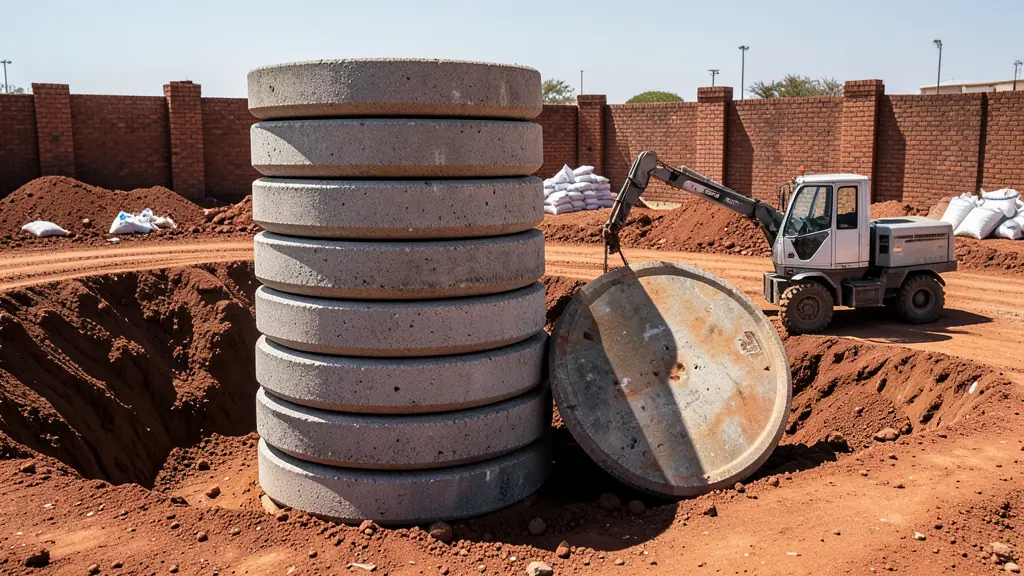
Concrete septic tanks have been part of South African homes and farms for generations, and many are still working after thirty years. They are heavy, solid and difficult to damage, so they suit drives, farm tracks and ground where a lighter tank might shift. You can buy a factory-made concrete tank, stack ring sections, or have a tank built in place from brick or poured concrete. Tell us what you need and suppliers and builders in your area will quote you.
Ring tanks, factory-made tanks and built-in-place tanks
There are three common routes. Concrete rings are stacked in a round hole, sealed at the joints and closed with a slab or lid, and they are popular for farm and smallholding use. Factory-made concrete tanks are cast in one or two sections, delivered by crane truck and lowered into place. Built-in-place tanks use poured concrete or face-brick tank sides with a rendered, waterproofed floor, usually where access is tight or the shape is unusual.
Whichever you choose, the tank needs two chambers or a second tank, with inlet and outlet tees to hold back scum and sludge.
Heavy lids and safety
A concrete lid is heavy, which keeps children and animals out and lets light vehicles pass over it. It can also be awkward for the pump-out crew, so ask for a lid with a lifting handle and a smaller inspection opening above each chamber. Never leave an opening uncovered: septic gases can overcome a person in seconds. Mark the lid positions on your site plan so a septic tank cleaning operator finds them quickly.
Raise the access point to just below ground level with a collar, so the lid can be uncovered in minutes without digging, and keep shrubs with aggressive roots away from the tank and its joints.
Cracks, leaks and sealing
Concrete tanks fail slowly. Acid in the waste attacks the roof above the liquid, joints between rings open as the ground moves, and hairline cracks let groundwater in or effluent out. Signs include a tank that fills quickly after rain, a level that never settles or damp patches around the lid.
Repairs include cementitious waterproofing, epoxy or polymer linings and resealing ring joints. A tank beyond repair is replaced, sometimes by dropping a plastic septic tank into the old shell. A septic tank service visit can include an inspection and a leak test.
What a concrete tank costs
A delivered and installed concrete tank of 3,000 to 6,000 litres commonly costs R9,000 to R22,000, depending on the region, crane hire and excavation. Built-in-place tanks are priced by labour and materials, and ring tanks by the number of rings. Compare quotes on the same size, with or without the lid, delivery and drainage. More on costs in septic tank prices.
What to include in your request
- Tank size in litres, or the number of people using it
- Rings, a factory-made tank or a built-in-place tank
- Access for a crane truck, and the distance to the hole
- Whether the old tank is cracked, leaking or being replaced
- Any vehicle traffic over the tank or lid position
Concrete Septic Tanks for different properties
- Houses: a concrete tank to replace or repair an old two-chamber tank at an off-sewer house
- Smallholdings and plots: stacked rings for a smallholding where a crane truck can reach the site
- Estates and complexes: a large built-in-place tank shared by cottages, with a lid rated for vehicles
- Farms and game farms: rings and tanks for worker housing, built with local labour and materials
- Lodges, guesthouses and venues: big concrete tanks for chalets, set away from guest areas with good ventilation
- Restaurants, shops and offices: a heavy tank behind a shop or garage, often under a parking area
- Schools, churches and clinics: large tanks for schools and churches, repaired during school holidays
- Factories, mines, sites and events: heavy-duty tanks for depots and works where trucks pass over the lids
Frequently asked questions
How long does a concrete septic tank last?
Can I build my own concrete septic tank?
How do I know if my concrete tank is leaking?
Is concrete or plastic better for a driveway?
Concrete Septic Tanks by province and city
- Johannesburg
- Pretoria
- Centurion
- Midrand
- Sandton
- Randburg
- Roodepoort
- Krugersdorp
- Randfontein
- Germiston
- Boksburg
- Benoni
- Kempton Park
- Alberton
- Vanderbijlpark
- Vereeniging
- Durban
- Pinetown
- Pietermaritzburg
- Richards Bay
- Newcastle
- Ladysmith
- Gqeberha (Port Elizabeth)
- East London
- Kariega (Uitenhage)
- Mthatha
- Cape Town
- Bellville
- Paarl
- Stellenbosch
- George
- Worcester
- eMalahleni (Witbank)
- Middelburg
- Secunda
- Mbombela (Nelspruit)
- Rustenburg
- Brits
- Klerksdorp
- Potchefstroom
- Mahikeng
- Polokwane
- Tzaneen
- Kimberley
- Upington
- Bloemfontein
- Welkom
- Sasolburg