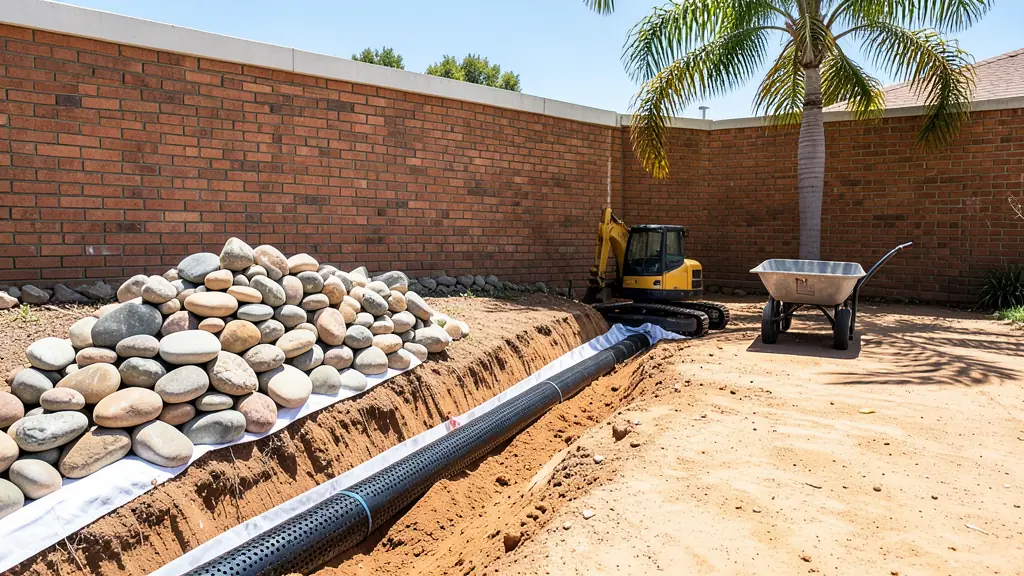
In South Africa the term french drain means two different things. One is the trench of stone and perforated pipe that takes the water from a septic tank and lets it soak into the ground. The other is a stormwater drain that collects rain and groundwater around a house, wall or patio and carries it away. Both are built the same way. Tell us which you need and where you are, and drainage contractors near you will quote directly.
A french drain for a septic tank
Here the trench is the final step of the system. Settled liquid leaves the tank through the outlet and runs into perforated pipe laid with a slight fall inside a bed of clean 25 to 38 mm stone, wrapped in geotextile to keep soil out. The water seeps out of the holes, through the stone and into the surrounding ground. Most plots need 20 to 60 metres of trench, laid out in lines or a fan, depending on the household size and on how the ground drains. The tank must be sized and cleaned properly first: see septic tank cleaning.
A french drain for stormwater
Around a house, the same trench sits at a shallow depth beside a damp wall, along the foot of a retaining wall, under a lawn that stays soggy or across a slope above a patio. It does not take sewage. Instead it intercepts surface and groundwater and carries it by gravity to a stormwater drain, a swale or a lower part of the property. It is a cheaper fix than waterproofing a wall that is damp from the outside. Water that is not carried away from foundations can also crack floors and walls over a few wet seasons, so the drain is worth building before that happens. Always keep stormwater out of the septic tank and its pipes.
What a good job includes
Ask the contractor about these points before you accept a quote:
- The depth, width and length of the trench and the grade of the pipe.
- Clean washed stone, not crusher dust or builder's rubble, which clogs.
- Geotextile wrapped around the stone, and a top layer of topsoil or gravel.
- Inspection points or clean-outs at the ends and bends.
- For septic work, a percolation test and the municipal approval where required.
If the ground is heavy clay or the water table is high, a trench may not soak enough and a soakaway or raised field may suit better.
Replacing an old french drain
Old drains fail when silt, roots or a crushed pipe block the flow. Contractors excavate the trench, remove and wash or replace the stone, renew the pipe and fabric, and backfill. A drain that failed because of a full tank will fail again unless the tank is fixed too. See septic tank drainage for how failures are diagnosed. Ask whether the old stone can be reused, since washed stone in good condition saves money.
What to include in your request
- Whether the drain is for a septic tank or for stormwater
- Roughly how long the trench needs to run, and on what slope
- Soil type (clay, sand, rock) and whether the ground floods
- Where the water must go: a pit, a lower garden or a stormwater drain
- Whether an old drain must be dug up and replaced
French Drains for different properties
- Houses: a trench for a septic tank at an older house, or a stormwater drain along a damp wall
- Smallholdings and plots: a longer septic trench on a smallholding, plus drains that carry runoff off the yard
- Estates and complexes: stormwater french drains around units and communal gardens, with septic trenches where off-sewer
- Farms and game farms: septic trenches for homesteads and drains that protect buildings and roads from runoff
- Lodges, guesthouses and venues: larger trenches for peak guest loads and drains that keep paths and decks dry
- Restaurants, shops and offices: stormwater trenches for parking and retail frontages, and septic trenches for rural shops
- Schools, churches and clinics: long trenches for school and church septic systems, and drains keeping playgrounds dry
- Factories, mines, sites and events: drains on yards, depots and building sites where runoff would otherwise pond
Frequently asked questions
How much does a french drain cost in South Africa?
Is a french drain the same as a soakaway?
How deep should a french drain be?
Will a french drain work in clay soil?
French Drains by province and city
- Johannesburg
- Pretoria
- Centurion
- Midrand
- Sandton
- Randburg
- Roodepoort
- Krugersdorp
- Randfontein
- Germiston
- Boksburg
- Benoni
- Kempton Park
- Alberton
- Vanderbijlpark
- Vereeniging
- Durban
- Pinetown
- Pietermaritzburg
- Richards Bay
- Newcastle
- Ladysmith
- Gqeberha (Port Elizabeth)
- East London
- Kariega (Uitenhage)
- Mthatha
- Cape Town
- Bellville
- Paarl
- Stellenbosch
- George
- Worcester
- eMalahleni (Witbank)
- Middelburg
- Secunda
- Mbombela (Nelspruit)
- Rustenburg
- Brits
- Klerksdorp
- Potchefstroom
- Mahikeng
- Polokwane
- Tzaneen
- Kimberley
- Upington
- Bloemfontein
- Welkom
- Sasolburg