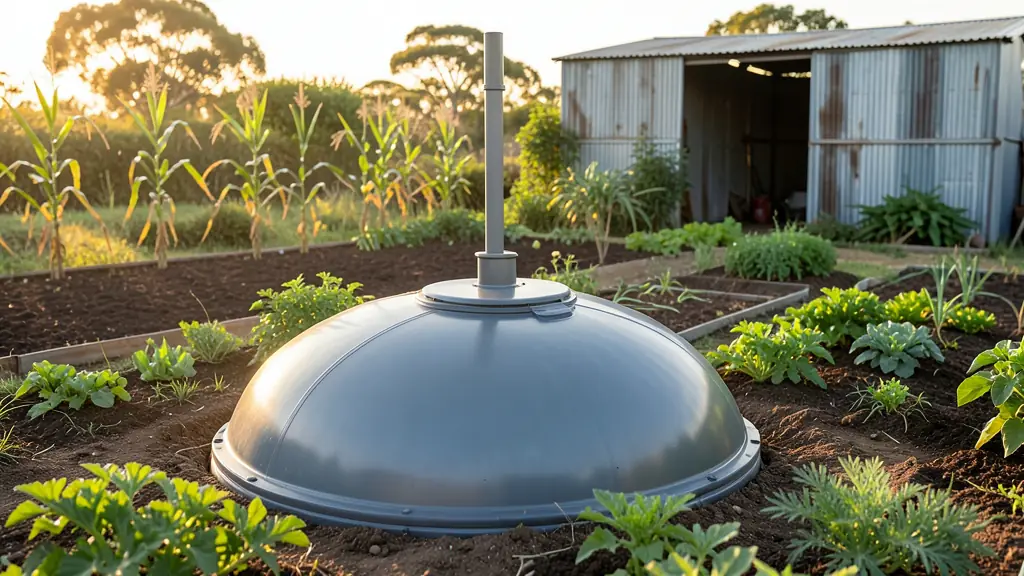
A biodigester is a sealed, airtight tank that lets bacteria break down toilet and kitchen waste without oxygen. Households use it as an alternative to a conventional septic tank, and it can also capture a little biogas for a stove. Many plots and farms off the municipal sewer now ask about them. Tell us your property, number of users and soil, and suppliers who install digesters in your area will quote you directly. A good supplier will also explain what the unit can and cannot treat, what the municipality expects and what upkeep to plan for, so you can compare real options.
How a household biodigester works
Waste flows into a sealed chamber where anaerobic bacteria feed on it in the dark. As they digest the solids, they release methane and carbon dioxide, which collect under the dome and leave through a gas pipe. The liquid that remains is much cleaner than raw sewage and passes on to a soakaway or a planted filter bed.
Because the tank is airtight and kept warm by the ground around it, the process needs very little electricity and almost no daily attention. Some designs add a second chamber or a reed bed to polish the water further before it reaches the soil, which suits sensitive sites such as sandy ground or a high water table.
Biogas in simple terms
Biogas is mostly methane, the same gas that burns in a camping stove. A toilet-fed digester makes only a small amount, enough to run a single burner for short periods, not to heat a whole house. Output rises when you add kitchen scraps or manure, and drops in cold Highveld winters.
Treat the gas as a bonus. The real purpose of the system is treating waste, so ask suppliers for the vented, non-explosive layout and never plan around biogas as your main fuel. Pipework should be sealed, kept away from ignition sources and checked for leaks, because methane is flammable in enclosed spaces.
Septic tank vs biodigester
- Treatment: a septic tank settles solids in two chambers, while a digester actively breaks them down.
- Sludge: a digester builds up slowly, so pump-outs are far less frequent than for a typical septic tank.
- Cost: expect a higher purchase price but lower running costs.
- Climate: digesters work best in warm areas and slow down in frost.
Sizing, siting and approvals
Size the unit by the number of users and by whether it takes only toilets or also kitchen and bathroom water. Most households choose tanks from 3,000 to 10,000 litres. Keep it clear of boreholes, rivers and the foundations of buildings, and leave room for a truck to reach the inspection lid. Your municipality may need plans and approval first, so check before you buy. A sewage treatment plant suits larger estates and lodges better. Ask the supplier who handles the first start-up, since the bacteria need a few weeks to settle and the unit performs best when it is loaded steadily rather than flooded with a large party in its first month.
What to include in your request
- Number of people using the toilets and bathrooms
- Whether kitchen and bath water will also enter
- Soil type and distance to boreholes or streams
- Whether you want biogas for cooking
- Your municipality and any plans already approved
Biodigesters for different properties
- Houses: a compact digester that replaces an old septic tank at an off-sewer house
- Smallholdings and plots: a larger digester with biogas for the kitchen and treated water for the garden
- Estates and complexes: a shared digester for a small cluster, with approval from the body corporate
- Farms and game farms: digesters for worker housing, sometimes fed with manure to raise biogas output
- Lodges, guesthouses and venues: a digester sized for seasonal guest numbers, paired with a filter bed
- Restaurants, shops and offices: a small unit for a roadside shop or office that is far from a sewer
- Schools, churches and clinics: a digester for a rural school or clinic where pump-out trucks are far away
- Factories, mines, sites and events: a site unit for staff ablutions at a quarry, depot or remote works
Frequently asked questions
How much does a biodigester cost?
Does a biodigester need emptying?
Can I connect an existing septic tank to a biodigester?
Will bleach or cleaning products harm it?
Biodigesters by province and city
- Johannesburg
- Pretoria
- Centurion
- Midrand
- Sandton
- Randburg
- Roodepoort
- Krugersdorp
- Randfontein
- Germiston
- Boksburg
- Benoni
- Kempton Park
- Alberton
- Vanderbijlpark
- Vereeniging
- Durban
- Pinetown
- Pietermaritzburg
- Richards Bay
- Newcastle
- Ladysmith
- Gqeberha (Port Elizabeth)
- East London
- Kariega (Uitenhage)
- Mthatha
- Cape Town
- Bellville
- Paarl
- Stellenbosch
- George
- Worcester
- eMalahleni (Witbank)
- Middelburg
- Secunda
- Mbombela (Nelspruit)
- Rustenburg
- Brits
- Klerksdorp
- Potchefstroom
- Mahikeng
- Polokwane
- Tzaneen
- Kimberley
- Upington
- Bloemfontein
- Welkom
- Sasolburg