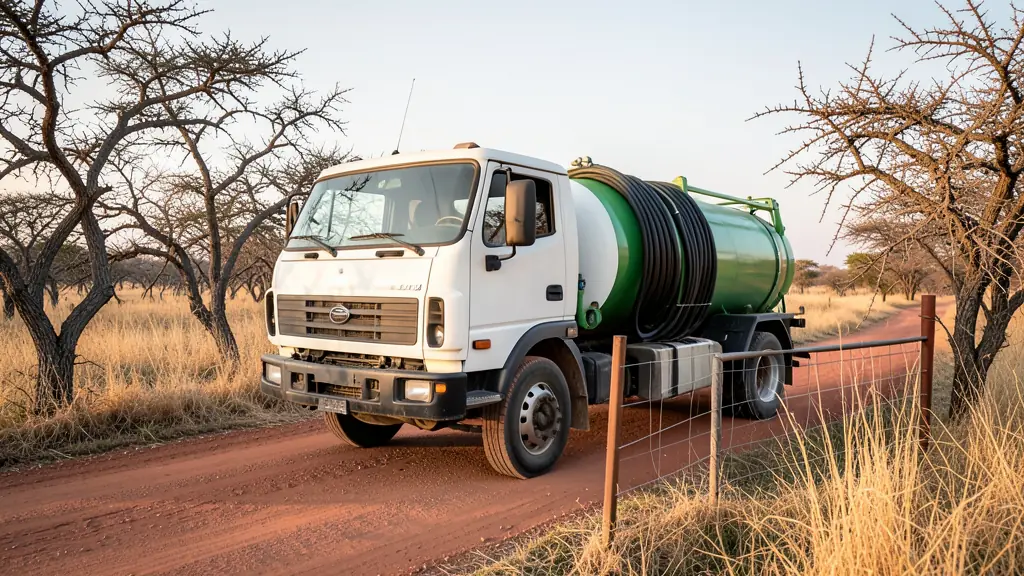
A honey sucker is the everyday South African name for a vacuum tanker truck, and for the small business that runs it. The operator brings a pump, a tank and a long set of hoses to empty septic tanks, conservancy tanks, pit latrines and grease traps. The service covers towns, farms and rural roads alike. We do not own any trucks: you send one request, and independent honey sucker operators in your area quote you directly.
What a honey sucker operator does
The driver reverses to the tank, couples hoses to the truck's vacuum pump and draws the contents into the tank on the chassis. Once the load is full, or the job is done, the truck drives to a municipal treatment works or licensed disposal site. Many operators also carry high-pressure water to loosen hard sludge and to rinse out a trap or sump afterwards.
It is a small trade, so one person often answers the phone, drives the truck and handles the paperwork. Clear information in your request saves them a call back, and tells them which truck to send before they leave the yard.
Truck sizes and what they mean
Tankers are measured in kilolitres (kL), where one kilolitre is 1,000 litres.
- 3 to 6 kL: small trucks for tight lanes, steep driveways and townhouse complexes.
- 8 to 12 kL: the most common size, suited to household and small business tanks.
- 14 to 18 kL: big rigs for estates, schools, lodges and industrial sites, which need firm, wide access.
A bigger truck makes fewer trips to disposal, but may not fit your gate. Tell the operator your gate width and the surface of the driveway.
Access, hoses and disposal
Most trucks carry 30 to 60 metres of hose, and some carry more. Longer runs cost more because the pump must work harder and the job takes longer. The truck needs level, firm ground: a heavy tanker can sink into wet sand or clay, and a damaged driveway is your problem, not the operator's.
Disposal is regulated, so reputable operators tip only at authorised sites and pay a dumping fee that appears on your quote. For a single pump-out see septic tank pumping, and for scheduled work on sealed tanks see conservancy tank emptying.
Choosing between operators
Compare quotes on the same facts: the truck size, litres to be removed, travel charge, dumping fee and VAT. Ask whether the operator has a valid disposal permission and will give you a slip. A very low price often means the load is dumped illegally, which can leave you liable. If you run a fleet or hire your own vehicle, see honey sucker trucks for sale instead.
What to include in your request
- The kind of tank: septic, conservancy, pit or grease trap
- Tank volume in litres, or a rough guess if you are unsure
- Gate width, driveway surface and any steep or soft ground
- Distance in metres from where the truck can stand to the tank
- Your address, plus a phone number for the driver on the day
Honey Sucker Services for different properties
- Houses: a small or mid-size truck that fits the street and reaches the tank in one visit
- Smallholdings and plots: a 10 kL truck with extra hose for long driveways, gravel roads and big tanks
- Estates and complexes: a large truck on a scheduled round, with gate access arranged through security
- Farms and game farms: a rugged truck that handles dirt roads, with several tanks cleared in one trip
- Lodges, guesthouses and venues: reliable trucks that arrive between guest changeovers and work without disturbing guests
- Restaurants, shops and offices: a regular operator who knows the site and works around trading hours
- Schools, churches and clinics: a large tanker booked for holidays, with paperwork for the school or clinic
- Factories, mines, sites and events: high-capacity trucks and several loads per day for sites with waste records
Frequently asked questions
Why is it called a honey sucker?
How much does a honey sucker cost?
Can a honey sucker empty a pit latrine?
What should I have ready when the truck arrives?
Honey Sucker Services by province and city
- Johannesburg
- Pretoria
- Centurion
- Midrand
- Sandton
- Randburg
- Roodepoort
- Krugersdorp
- Randfontein
- Germiston
- Boksburg
- Benoni
- Kempton Park
- Alberton
- Vanderbijlpark
- Vereeniging
- Durban
- Pinetown
- Pietermaritzburg
- Richards Bay
- Newcastle
- Ladysmith
- Gqeberha (Port Elizabeth)
- East London
- Kariega (Uitenhage)
- Mthatha
- Cape Town
- Bellville
- Paarl
- Stellenbosch
- George
- Worcester
- eMalahleni (Witbank)
- Middelburg
- Secunda
- Mbombela (Nelspruit)
- Rustenburg
- Brits
- Klerksdorp
- Potchefstroom
- Mahikeng
- Polokwane
- Tzaneen
- Kimberley
- Upington
- Bloemfontein
- Welkom
- Sasolburg