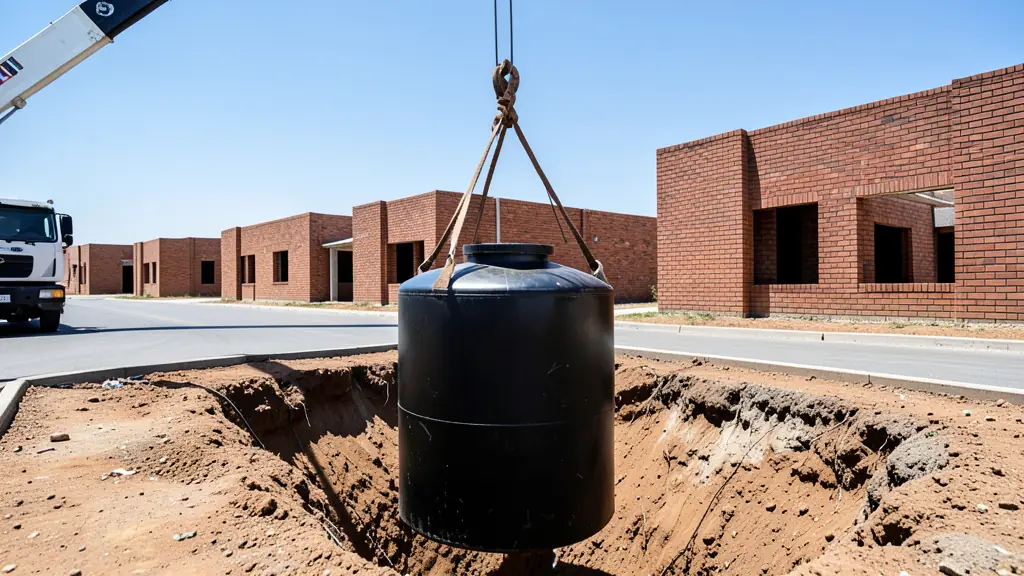
A conservancy tank is a sealed holding tank with no outlet and no soakaway. Everything flushed into it stays there until a honey sucker truck empties it. Municipalities often require one where the ground cannot take drainage, where the water table is high or where a sewer is planned but not yet built. This page covers buying and installing the tank itself. Tell us what you need and suppliers near you will quote.
When a conservancy tank is required
A municipality may refuse a septic tank and insist on a conservancy tank for several reasons: a high water table, dolomite or fractured rock, a small stand with no room for a drainage field, closeness to a river or borehole, or a property in a sewer area that has not been connected. Estates and sectional title complexes use them to serve several units. Some owners also choose one by preference, to avoid any discharge near a borehole. If you are unsure, ask your municipality what it accepts for your stand before you buy.
Septic tank versus conservancy tank
- Septic tank: treats the waste in two chambers, then sends the liquid to a soakaway or french drain. It needs pumping every few years.
- Conservancy tank: stores everything, with no discharge. It needs emptying every few weeks or months, which means ongoing truck costs.
A conservancy tank is cheaper to install because it needs no drainage field, but it costs much more to run. Compare both before deciding, and read septic tank design for the other option.
Sizing for your emptying interval
Size the tank for how often you are willing to pay for a truck. A person uses roughly 100 to 150 litres of water a day, so a family of four sends about 500 litres daily into the tank. A 10,000 litre tank then lasts about three weeks, and a 30,000 litre tank about two months. Bigger tanks mean fewer trips but a larger hole and higher upfront cost. Leave a safety margin, add a high-level alarm and make sure a truck can reach the lid.
Remember that rainwater leaking in through a poor lid or cracked collar fills the tank fast, so a tight seal saves real money.
Buying and installing a sealed tank
JoJo and other makers sell sealed polyethylene conservancy tanks, and concrete versions are built for larger sites. The tank must be watertight, vented and rated for burial, with the inlet at the right depth. In wet ground it needs anchoring against flotation. Expect roughly R12,000 to R45,000 for a 5,000 to 20,000 litre tank, installed. Ask who will connect the inlet pipe, fit the vent and test the tank for leaks before it is covered, since a sealed tank that seeps is a costly mistake. Once in service, conservancy tank emptying covers the pump-out schedule and costs.
What to include in your request
- Daily water use, or the number of people and units
- How often you want the tank emptied
- Why the tank is needed: municipal rule, high water or rock
- Tank material wanted: plastic or concrete
- Truck access to the lid and to the excavation
Conservancy Tanks for different properties
- Houses: a sealed tank for a house on a small stand where a drainage field will not fit
- Smallholdings and plots: a holding tank where rock or a high water table rules out a soakaway
- Estates and complexes: large linked tanks for a complex awaiting a sewer, with a pump-out schedule
- Farms and game farms: a sealed tank near a borehole or river where discharge is not allowed
- Lodges, guesthouses and venues: big tanks with a high-level alarm for chalets in sensitive areas, emptied on a regular round
- Restaurants, shops and offices: a holding tank for a shop or filling station with an upstream grease trap
- Schools, churches and clinics: sealed tanks for a school or clinic, sized for the term-time load
- Factories, mines, sites and events: bulk holding tanks for sites and works that must not discharge on the ground
Frequently asked questions
Is a conservancy tank cheaper than a septic tank?
How big should my conservancy tank be?
Can I convert a septic tank to a conservancy tank?
Will the municipality inspect my conservancy tank?
Conservancy Tanks by province and city
- Johannesburg
- Pretoria
- Centurion
- Midrand
- Sandton
- Randburg
- Roodepoort
- Krugersdorp
- Randfontein
- Germiston
- Boksburg
- Benoni
- Kempton Park
- Alberton
- Vanderbijlpark
- Vereeniging
- Durban
- Pinetown
- Pietermaritzburg
- Richards Bay
- Newcastle
- Ladysmith
- Gqeberha (Port Elizabeth)
- East London
- Kariega (Uitenhage)
- Mthatha
- Cape Town
- Bellville
- Paarl
- Stellenbosch
- George
- Worcester
- eMalahleni (Witbank)
- Middelburg
- Secunda
- Mbombela (Nelspruit)
- Rustenburg
- Brits
- Klerksdorp
- Potchefstroom
- Mahikeng
- Polokwane
- Tzaneen
- Kimberley
- Upington
- Bloemfontein
- Welkom
- Sasolburg