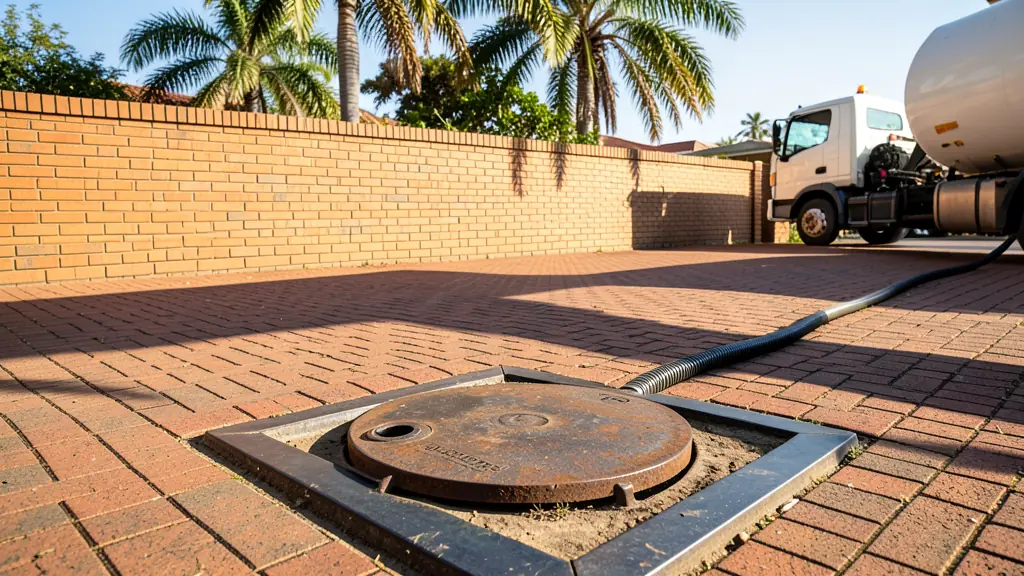
A conservancy tank is a sealed holding tank with no outlet and no soakaway, so everything that goes in stays in until a tanker takes it away. That makes conservancy tank emptying a regular chore rather than an occasional one: every few days for a busy building, or every few weeks for a family home. Send your details and municipal or private tanker operators will quote a once-off or a repeating schedule.
How a conservancy tank differs from a septic tank
A septic tank lets treated liquid flow out to a soakaway or drainage field and keeps only the solids. A conservancy tank holds all of it. There is no outlet at all, which is why these tanks are used where the ground cannot take drainage: dolomite areas, high water tables, tiny stands and dense town properties without a sewer connection.
Because every flush goes into the tank, it fills far faster. A 9,000 litre tank serving four people may be full in two to four weeks. Buying one is covered under conservancy tanks.
Municipal or private tanker
Some municipalities run their own vacuum trucks and charge a regulated tariff, but waiting lists can be long and they may only serve certain suburbs. Private operators usually respond faster, give you a time window and can set up a repeat schedule.
- Municipal: lower tariff in some areas, fewer choices, slower response.
- Private: faster, flexible, and prices that vary, so compare at least two quotes.
Check that either option disposes at an authorised works, and ask for proof if your estate or lender needs it.
Setting an emptying schedule
The right schedule is the tank volume divided by what the property sends in each day. A rough starting point is to empty before the tank is three quarters full. Many owners fit a level alarm or ask the operator to mark the dipstick reading on each visit.
Estates and body corporates often arrange fixed days, such as every Tuesday and Friday, with access through the gate arranged in advance. Lodges ask for more trips in peak months. A missed collection can lead to an overflow into the garden or the road, which is both a health risk and a fine.
What the price depends on
The price per emptying follows the volume removed, distance to the disposal site, the municipal tipping fee and the time the truck waits. A repeat contract usually lowers the cost per visit and secures a slot in busy weeks. When the monthly bill climbs, it may be cheaper to switch to a septic tank or a treatment plant, so also read about sewage treatment plants. For a general view of how operators work, see honey sucker services.
What to include in your request
- Tank volume in litres and how many people use it
- How quickly the tank fills, in days or weeks
- Whether you need a once-off job or a repeating schedule
- Whether the municipality currently collects from you
- Gate access, security arrangements and the preferred days
Conservancy Tank Emptying for different properties
- Houses: emptying a sealed tank every few weeks where the stand has no sewer or soakaway
- Smallholdings and plots: regular emptying where the ground cannot take drainage, with fewer visits for big tanks
- Estates and complexes: fixed weekly collections for shared sealed tanks, with gate access booked in advance
- Farms and game farms: scheduled emptying of sealed tanks near homesteads and staff housing in sensitive ground
- Lodges, guesthouses and venues: extra emptying in peak season, with a level alarm to avoid overflows near guests
- Restaurants, shops and offices: frequent emptying for shops and offices in town centres with no sewer link
- Schools, churches and clinics: scheduled collections for schools and churches, with receipts for the records
- Factories, mines, sites and events: emptying holding tanks on building sites and factories where there is no treatment
Frequently asked questions
How often must a conservancy tank be emptied?
How much does emptying a conservancy tank cost?
What happens if the tank overflows?
Can I reduce how often I have to empty it?
Conservancy Tank Emptying by province and city
- Johannesburg
- Pretoria
- Centurion
- Midrand
- Sandton
- Randburg
- Roodepoort
- Krugersdorp
- Randfontein
- Germiston
- Boksburg
- Benoni
- Kempton Park
- Alberton
- Vanderbijlpark
- Vereeniging
- Durban
- Pinetown
- Pietermaritzburg
- Richards Bay
- Newcastle
- Ladysmith
- Gqeberha (Port Elizabeth)
- East London
- Kariega (Uitenhage)
- Mthatha
- Cape Town
- Bellville
- Paarl
- Stellenbosch
- George
- Worcester
- eMalahleni (Witbank)
- Middelburg
- Secunda
- Mbombela (Nelspruit)
- Rustenburg
- Brits
- Klerksdorp
- Potchefstroom
- Mahikeng
- Polokwane
- Tzaneen
- Kimberley
- Upington
- Bloemfontein
- Welkom
- Sasolburg