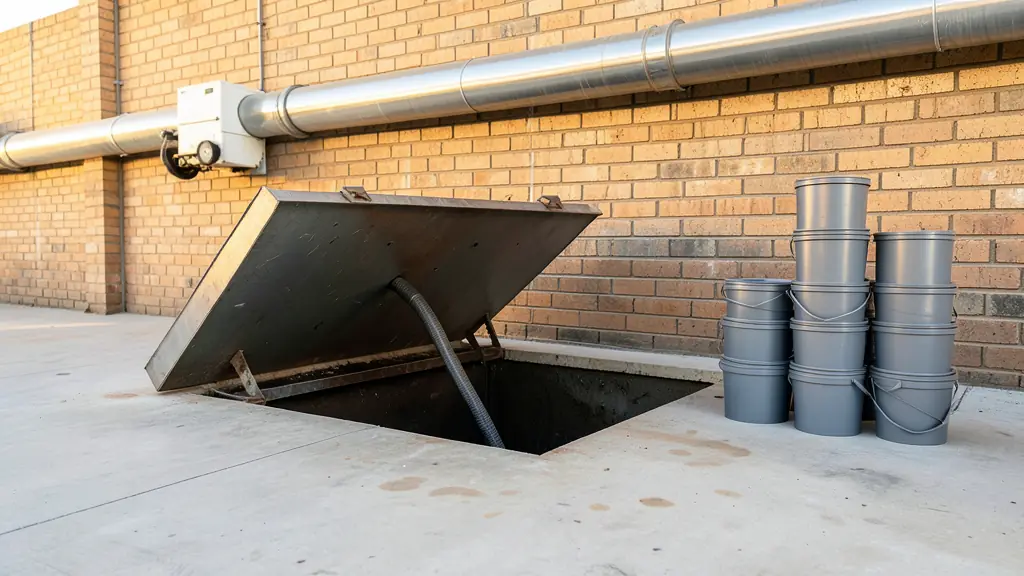
Every kitchen sink and dishwasher sends hot, fatty water down the drain, and that fat sets hard as soon as it cools. A grease trap catches it before it can coat the pipes. Grease trap cleaning removes the layer of fat, oil and food scraps that builds up inside the trap so it keeps working. Skip it and the trap overflows, the drain blocks and the kitchen smells. Tell us about your trap and where you are, and licensed operators in your area will quote you directly.
How a grease trap is cleaned
The operator lifts the lid, skims or pumps out the floating fat, then removes the watery middle layer and the heavy food solids on the bottom. A proper clean empties the whole trap, scrapes the walls and baffles, and checks that the inlet and outlet pipes are clear before the trap is refilled with clean water.
Be wary of anyone who only skims the top layer and leaves the rest. The waste goes to a licensed site that accepts fats and oils, and you should receive a slip that shows the date and volume removed.
How often to service a trap
There is no single schedule. A busy takeaway fryer can fill a small trap in a fortnight, while a quiet office canteen may only need a service every two to three months. These factors decide it:
- Trap size: a 50 litre under-sink unit fills far sooner than a 1,000 litre in-ground chamber.
- Menu: fried food, curries and anything cooked in oil produce the most fat.
- Trading hours: more covers mean more dishwashing and more grease.
A common rule is to clean once the fat and solids fill about a quarter of the trap's depth. Many municipalities also set a minimum frequency in their by-laws.
Signs the trap needs attention
- A sour, rancid smell around the kitchen floor drains or the trap lid.
- Sinks that drain slowly or gurgle when the dishwasher empties.
- Grease visible in the outside manhole or floating on top of the trap.
- Flies and cockroaches gathering near the drain.
If the trap feeds a septic tank or conservancy tank, fat that slips past it will coat the tank and clog the soakaway, so cleaning the trap protects the whole system. A blocked line after the trap may need drain unblocking as well.
What affects the price
Operators price by trap size and volume removed, plus travel. Hard, compacted grease costs more because it takes longer to break up. Traps that sit in a tight basement or behind locked gates also add time. Regular contracts are usually cheaper per visit than one-off emergency call-outs. Ask whether the quote includes disposal and a service record, and whether the operator will report cracked lids or damaged baffles. A trap that is cleaned on time is also a much smaller job than one left until it overflows, so a regular visit usually saves money.
What to include in your request
- Trap type: under-sink, in-ground or large chamber, and size if known
- What the kitchen cooks and roughly how many meals a day
- When it was last cleaned and how long it took to fill
- Where the lid is and whether it is under a table or paving
- Whether you need a regular contract and a service slip
Grease Trap Cleaning for different properties
- Houses: a small under-sink trap at a home business kitchen or a granny flat with a full kitchen
- Smallholdings and plots: a trap on a farm stall, deli or catering kitchen run from a smallholding
- Estates and complexes: traps at a clubhouse restaurant or communal kitchen, serviced on a body corporate schedule
- Farms and game farms: traps at farm kitchens, worker canteens and packing sheds that cook for many people
- Lodges, guesthouses and venues: heavy-use traps at lodge and venue kitchens that peak during weddings and holiday seasons
- Restaurants, shops and offices: frequent cleaning of restaurant, takeaway and food court traps to meet by-laws and landlords
- Schools, churches and clinics: scheduled cleaning of school, hospital and church hall kitchen traps, often in the holidays
- Factories, mines, sites and events: large traps at food factories and staff canteens with a waste slip for each visit
Frequently asked questions
How much does grease trap cleaning cost?
Can I clean the grease trap myself?
Do enzymes or bacteria replace pumping?
Does my business need a service certificate?
Grease Trap Cleaning by province and city
- Johannesburg
- Pretoria
- Centurion
- Midrand
- Sandton
- Randburg
- Roodepoort
- Krugersdorp
- Randfontein
- Germiston
- Boksburg
- Benoni
- Kempton Park
- Alberton
- Vanderbijlpark
- Vereeniging
- Durban
- Pinetown
- Pietermaritzburg
- Richards Bay
- Newcastle
- Ladysmith
- Gqeberha (Port Elizabeth)
- East London
- Kariega (Uitenhage)
- Mthatha
- Cape Town
- Bellville
- Paarl
- Stellenbosch
- George
- Worcester
- eMalahleni (Witbank)
- Middelburg
- Secunda
- Mbombela (Nelspruit)
- Rustenburg
- Brits
- Klerksdorp
- Potchefstroom
- Mahikeng
- Polokwane
- Tzaneen
- Kimberley
- Upington
- Bloemfontein
- Welkom
- Sasolburg