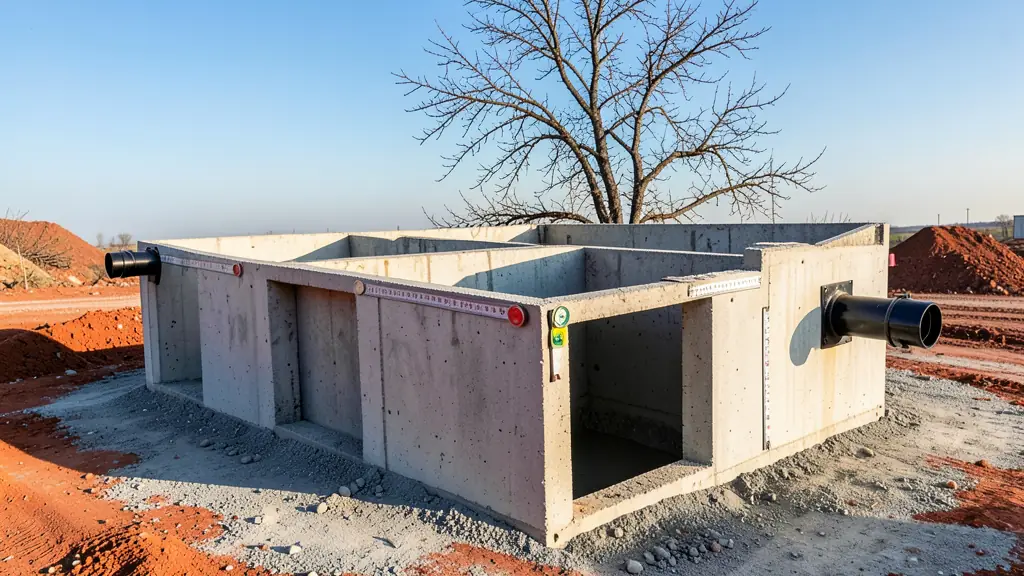
A septic tank has to hold at least one day of the building's sewage so solids have time to settle and scum can rise before the liquid flows to the soakaway. South African councils still size tanks from the tables in SABS 0400 (the code of practice for the National Building Regulations). This calculator applies those tables, adds the allowance for a washing machine or garbage grinder, and rounds up to a tank size you can actually buy.
How the size is worked out
For a house or flat the minimum is 1,700 litres for up to six rooms, plus 200 litres for every room over six. Rooms means habitable rooms: bedrooms, the lounge, a dining room and a study.
Tank (L) = 1,700 + 200 × (rooms − 6)
e.g. 8 rooms: 1,700 + 200 × 2 = 2,100 L
For other buildings such as guesthouses, schools, offices and restaurants the tank must hold three days of sewage, worked out from the number of people and the daily flow for that kind of building.
Tank (L) = people × litres per person per day × 3
e.g. a 30-bed boarding house: 30 × 110 × 3 = 9,900 L
An automatic washing machine adds about 40% to the flow and a garbage grinder about 20%; with both, add 60%. The calculator then rounds up to the next common tank size, because a slightly bigger tank costs little more and goes longer between pump-outs.
SABS 0400 sewage flow tables
| Bedrooms | Sewage flow, litres a day |
|---|---|
| 2 | 700 |
| 3 | 900 |
| 4 | 1,100 |
| 5 | 1,400 |
| Type of building | Litres per person a day |
|---|---|
| Boarding house | 110 |
| Hotel or guesthouse, shared bathrooms | 110 |
| Hotel or guesthouse, en-suite rooms | 140 |
| Restaurant (per patron) | 20 |
| Caravan park or camp with a bathhouse | 90 |
| Day school (per pupil) | 37 |
| Office (per worker per shift) | 90 |
| Factory (per worker per shift) | 140 |
| Clinic or hospital (per bed) | 500 |
| Motel (per bed) | 90 |
| Swimming baths (per swimmer) | 9 |
From SABS 0400-1990, as published by the City of Cape Town. One bedroom is taken as two; above five bedrooms the calculator adds 300 litres a day for each extra bedroom.
Why many installers go bigger
The SABS figure is a legal minimum, not a target. A family of four in a three-bedroom house with a washing machine comes out at about 2,400 litres, and most installers would fit a 2,500 litre tank. Going up to 3,000 or 4,000 litres is common on plots and farms because it stretches the pump-out interval, copes with visitors and holiday peaks, and gives the soakaway cleaner effluent.
- Plan for growth. A cottage, a second bathroom or a home business later adds load the tank was never sized for.
- Two chambers are better than one. A divided tank holds back more solids from the soakaway, which is the expensive part to replace.
- Depth matters. The liquid must be at least 1 m deep below the outlet, with at least 200 mm of air space under the lid.
- Kitchen grease. For guesthouses and restaurants, add a grease trap ahead of the tank.
Plastic, concrete or a conservancy tank?
Once you know the size, compare plastic septic tanks and JoJo-style tanks (light, quick to install, need careful backfill) with concrete tanks (heavy, durable, good under driveways with a proper slab). If the council will not allow a soakaway because of a high water table, clay or a small stand, you may need a sealed conservancy tank instead, sized for at least two days of flow and emptied by a honey sucker. The next step is to size the drainage with the soakaway size calculator.