
Selecting the Right Septic Tank for South African Conditions
Sizing and Capacity for Household Needs
South Africa’s soils range from sandy to expansive clay, and these differences place harsh demands on treatment systems. Selecting the right septic tank south africa depends on household needs, not guesswork. The number of occupants and their water habits determine the daily flow.
Here is what I weigh when sizing a unit:
- Occupant count
- Peak water usage
- Soil percolation rate
- Stormwater inflow
Underestimating these creates silent failures. A tank that is too small overflows, while an oversized tank drains improperly. Both scenarios introduce pathogens and costly repairs. The ideal unit matches capacity to daily generation, retaining wastewater for 24 to 48 hours. This retention allows solids to settle and bacteria to work. South African homeowners who study these factors dodge the hidden costs that follow poor decisions.
Material Choices: Concrete, Plastic, and Fibreglass
The material of your septic tank south africa determines how it handles the aggressive local elements. Concrete is the heavyweight champion, offering bulk and permanence. It resists movement in waterlogged areas, but it is prone to cracking if you have expansive clay soil that swells and shrinks with the seasons. A hairline fracture in a concrete tank can spell a slow, silent failure, letting groundwater seep in and untreated effluent leak out.
Plastic and fibreglass units are light, which means they are cheaper to transport and install. They are also immune to corrosion, a critical factor in coastal regions with salty air. However, their lightweight nature makes them vulnerable to floating if the groundwater table rises, unless you anchor them properly.
Allow me to rank my personal preferences for you:
1. Concrete: Best for heavy traffic areas, but demand a structural engineer’s report if you have shifting soils.
2. Plastic (Polyethylene): A budget-friendly option, but check the wall thickness for durability against sharp rocks.
3. Fibreglass: Excellent for chemical resistance, but it can be brittle and prone to damage during installation if you drop it.
The choice for your septic tank south africa boils down to soil type and water table depth. That plastic unit might look like a bargain, but if you live on the Mpumalanga escarpment with its rocky terrain, fibre glass will shred on the installation. Concrete is heavy, awkward, and requires a crane, but it laughs at the red clay menace when properly bedded. Do not romanticise the process. This is a decision about weight, longevity, and how much effort you are willing to invest in a hole in the ground. Choose the material that matches your site conditions, or you will be digging it up again sooner than you think.
Regulatory Compliance and Municipal Approval
Securing municipal approval for a septic tank south africa is a regulatory process that many homeowners underestimate. Each municipality applies its own interpretation of the National Building Regulations, and SANS 10400 is merely the baseline. I have seen approved plans stall for months because the geotechnical survey did not match the council’s records.
The approval process demands specific documentation, including:
- A detailed site plan showing the tank position relative to boreholes and boundaries
- A registered engineer’s sign-off on the drainage field design
- Proof of compliance with environmental health bylaws in your district
Coastal municipalities impose additional conditions. They may require a pollution control barrier or a specific setback from seasonal wetlands. The inspector holds the final word, and their checklist varies from town to town! A septic tank south africa approved in Polokwane might fail outright in Stellenbosch. The paperwork is not a formality; it is the difference between a legal installation and a costly demolition order.
Cost Considerations and Installation Factors
Selecting the correct septic tank south africa involves more than comparing price tags. The installation terrain often dictates the final cost, and a rocky plot can turn a budget option into an expensive ordeal. I have watched homeowners overlook the excavation depth until the quote arrived.
- Delivery access for the tank itself
- Groundwater table height at the site
- Distance to the drainage field
Installation factors also determine long-term performance. A poorly placed tank on a slope may require additional retaining work, and the soil permeability influences the drainage design. The total expense includes the tank, transport, hire of machinery, and the engineer’s certification. A septic tank south africa installed correctly gives decades of service, but cutting corners on the bedding layer or backfill compaction leads to immediate failures.
Septic Tank Installation Process in South Africa
Pre-Installation Site Assessment and Soil Testing
The earth knows what it can hold, long before we do. In South Africa, the installation of a septic tank south africa system begins not with a spade, but with a quiet investigation of the soil itself. This first dance is the pre-installation site assessment, and it is the difference between a system that hums for decades and one that fails before the paint dries. A geotechnical engineer or a seasoned installer will walk the property, reading the contours and the lie of the land.
The most critical variable is the percolation test, or “perc test.” You dig a hole, saturate the ground, and measure how fast the water disappears. If the soil is heavy clay, the water clings to itself, refusing to move, and your drain field will become a swamp of stagnant disappointment. If you have sandy, granular soil, the water vanishes quickly, but warn the groundwater may carry effluent too fast, bypassing the essential biological breakdown. A slow, steady absorption rate is the sweet spot, the hallmark of a robust septic tank south africa design.
The site assessment must also consider the seasonal water table. We have all seen the tragic sight of a waterlogged field after the summer rains. The contractor will check for the presence of bedrock and the distance to any boreholes or streams. This positioning protects your drinking water and your neighbours’ peace of mind.
The soil test will reveal the texture and structure, confirming the required depth for your trenching.
– The depth of the unsaturated soil layer.
– The proximity to any slope that might cause surface runoff.
– The location of existing trees whose roots are a constant threat to pipes.
Once the data is in, you know exactly where the tank will rest and how the drainage field will be oriented. This is the quiet, determined beginning of a sanitary journey. With the site vetted and the soil understood, the physical work of excavation can commence, a process that reshapes your property with purpose and precision. The call for a reliable septic tank south africa installation is the result of this careful planning.
Excavation and Positioning Guidelines
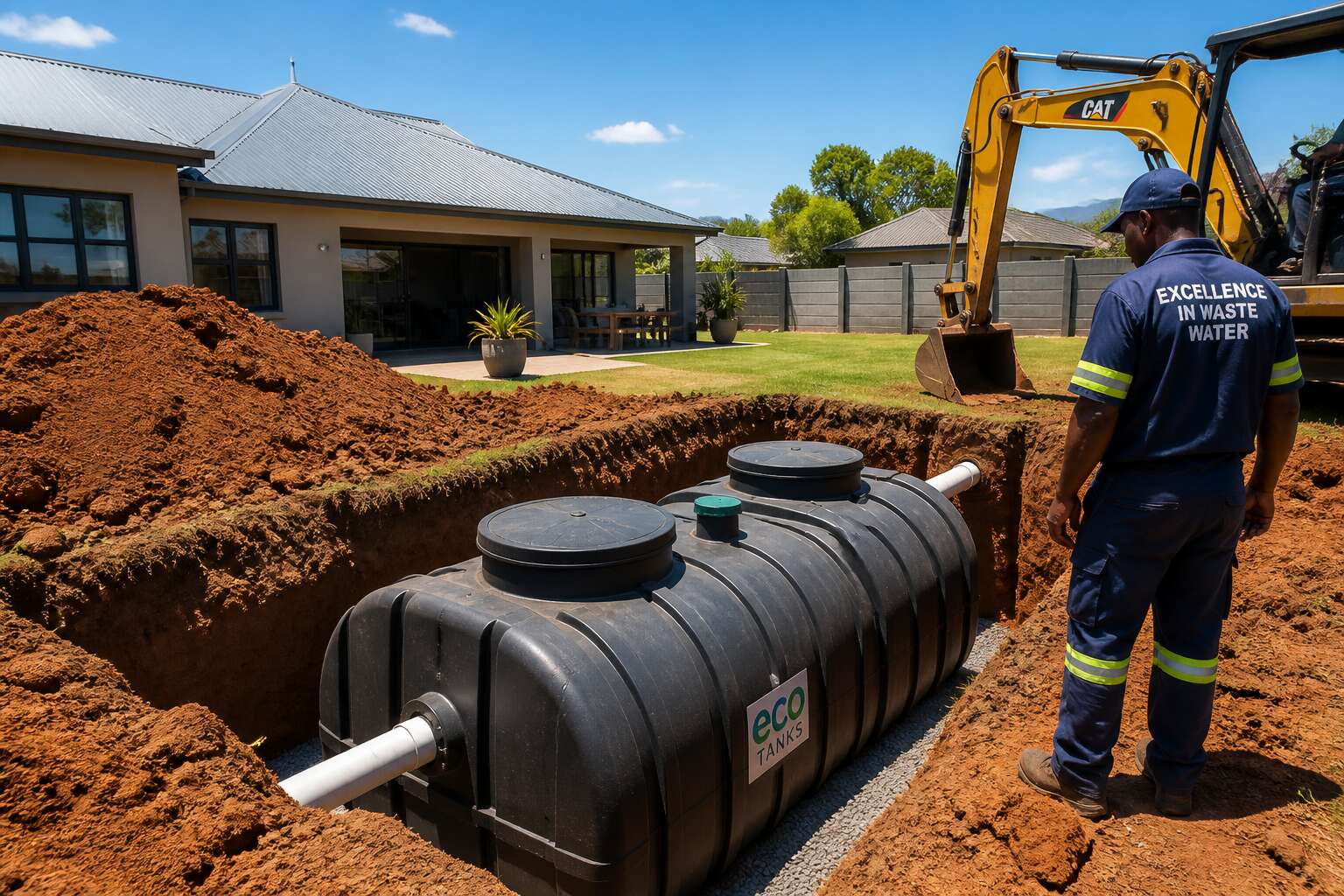
Excavation day arrives. A backhoe opens a hole in your yard, and the septic tank south africa affair feels very real. The hole must be deeper than the tank, but not so deep that the lid sits under a metre of soil.
Positioning is geometry and common sense. Keep the tank a few metres from the house and further from the boundary wall. The drain field runs downhill, never uphill, with the inlet pipe sloping at a steady fall of 1 to 2 percent.
- Check for buried cables and water pipes before the machine arrives.
- Dig wide enough for a person to stand beside the tank during installation.
- Place the tank on firm, undisturbed soil, not loose backfill.
Level the tank carefully. A tilted unit struggles with flow and may leak at the joints. Once it sits true, backfill with the excavated soil, compacting in layers. Do not drive heavy vehicles over the area afterwards. The ground needs time to settle, and your wallet needs a break from repairs.
Connecting Plumbing and Drainage Lines
Plumbing connections make or break the entire system. The inlet pipe must fall toward the tank at a steady 1 to 2 percent. Go steeper and liquids outrun solids, leaving clogged layers behind. I always dry fit the entire run before applying any glue. That simple step reveals misalignments you cannot see once solvent welds set.
The house drain should meet the tank inlet with a clean, straight alignment. Any kick creates turbulence, and turbulence means air locks. The outlet line heading to the drain field deserves the same respect. It needs its own consistent gradient, independent of the inlet.
- Dry fit every pipe, checking the laser level.
- Mark each joint, then disassemble.
- Apply primer and solvent cement, twisting into place.
After the glue cures, flush water through the entire run. Watch the inlet and outlet collars for weeping. A proper septic tank south africa installation lives or dies at these connections, regardless of tank quality.
Commissioning, Inspection, and First-Time Use
Commissioning begins with a final inspection before the excavator backfills. The tank must sit perfectly level, with risers and lids secure. I check the baffles and tee fittings thoroughly. A small crack hidden by dirt becomes a costly repair later.
The water test determines the tank’s integrity. Fill it to the outlet pipe and wait. The level should hold steady for an hour. Any drop points to a leak. Once confirmed watertight, the system is ready for service.
First-time use requires patience. The microbial colony inside needs weeks to mature, so households should moderate water usage during the first month. This lets anaerobic digestion establish itself properly. Every septic tank south africa installation depends on this delicate transition period.
Maintenance and Care for Septic Tanks in South Africa
Routine Pumping Intervals and Waste Disposal Practices
A septic tank south africa requires deliberate care, not occasional attention. The pump interval is the heartbeat of the whole system. In my experience, most blockages trace back to skipping that scheduled service. Every three to five years, call a certified pumper to remove the accumulated sludge and scum. Do not wait for smells or slow drains. Those signs mean the tank has already failed.
- Refuse to flush wipes, dental floss, or cigarette butts.
- Divert greywater from washing machines away from the soakaway.
- Compost food scraps instead of sending them into the tank.
Waste disposal habits shape the long term health of the unit. Biological additives are unnecessary. The natural bacteria already break down solids if you give them time. Avoid introducing antibiotics, bleach, or drain cleaners. Their residue kills that microbial population, turning the tank into a dead storage basin.
Signs of Septic Tank Failure: Odours, Backups, and Damp Spots
The first odour of rot across the lawn is a warning, not a nuisance. A septic tank south africa fails in stages. First comes the smell, a sour presence near the tank or the drain field that no breeze carries away. Then the plumbing protests.
Gurgling from the toilet after a flush, water backing into the shower tray, or waste that refuses to drain at all. These backups mean the tank cannot absorb what you send it. Damp spots follow. Patches of unnaturally green grass above the soakaway, or ground that stays wet without rainfall, expose effluent rising to the surface.
- Foul odours near the tank or drains
- Slow emptying toilets and sinks
- Soggy soil or excess plant growth
Act when the first sign appears. Delay escalates costs.
Biological Additives: Do They Really Help?
One shelf in every hardware store promises biological salvation. The bottles claim revived bacterial cultures and restored tank health. A septic tank south africa relies on living organisms to process household waste. Additives introduce those same organisms, or enzymes that dissolve fats and starches. Yet a healthy system already holds millions of active microbes. Pumping schedules, not potions, maintain the balance.
Some additives do serve a purpose! Enzyme treatments break down stubborn grease layers. Bacterial doses help restore the microbiome after a chemical spill or heavy antibiotic use in the home.
- Check the product label for live bacterial strains.
- Match the additive to the specific blockage.
- Avoid solvents and acid based cleaners.
Most products pass through the tank without meaningful effect. A septic tank south africa performs best with regular pumping and responsible water use. No bottle repairs a collapsed drain field or a cracked chamber.
Environmental Factors: High Water Table and Clay Soils
In the lowlands, the water table rises and the ground grows heavy. A septic tank south africa installed in saturated soil cannot drain. Effluent backs up through pipes and fixtures, turning the system into a flooded vault.
Clay soils complicate matters further. They swell with rain and crack under drought, shifting the earth around the tank. Drainage slows to a crawl. The system drowns in its own waste.
- Monitor groundwater levels before scheduling pumping
- Avoid directing irrigation toward the drain field
- Consider a raised mound system for persistent saturation
Every septic tank south africa in these conditions demands constant vigilance. The ground sets the terms, and the owner must comply.
Safe Cleaning Products for Septic Systems
Cleaning products pour down South African drains daily. Every bottle of bleach, every antibacterial wipe, disrupts the bacterial balance inside the septic tank south africa. These chemicals do not evaporate. They settle into the sludge layer and suppress the microbes responsible for digestion. Over time, the system slows, sludge accumulates, and pumping intervals shrink.
Managing a septic tank south africa properly means controlling what enters the wastewater stream. The microbial colony requires a stable habitat.
- Enzyme based drain cleaners
- White vinegar and bicarbonate of soda
- Low phosphate laundry detergents
These products break down without leaving toxic residue. The bacteria remain active, solids decompose steadily, and the drain field keeps functioning. Household cleaning routines, not additives, determine whether the colony thrives or dies.
Septic Tank Regulations and Environmental Impact in South Africa
National Building Regulations and SANS Codes
Beneath the red African soil, an unseen covenant exists between property owners and the environment. The National Building Regulations, alongside the formidable SANS 10400 guidelines, anchor the legality of every septic tank south africa installation. These codes are not mere suggestions; they are the statutory guardians of groundwater purity. When a tank is positioned incorrectly or fails to meet effluent standards, the consequences ripple outward, contaminating boreholes and streams. This regulatory framework dictates the precise distance from water sources and property boundaries, ensuring that waste management respects the delicate ecological balance that sustains the veld and its inhabitants.
The environmental impact of a failing system is profound. A leach field that cannot properly percolate becomes a source of pollution, not just a disposal mechanism. South Africa’s varied geological tapestry demands that these standards be taken seriously.
Specific pollution risks covered by SANS codes include:
– Nitrate and pathogen infiltration into shallow aquifers.
– Surface water contamination through stormwater runoff.
– The creation of anaerobic conditions that produce harmful methane.
The regulations evolved to mandate fail-safe designs, including approved drainage systems and treatment protocols. By intertwining legal compliance with ecological stewardship, the law ensures your hidden infrastructure functions as a quiet, responsible citizen of the landscape.
Local Municipality Bylaws and Permits
The National Building Regulations dictate the baseline, while local bylaws add a sterner layer of control. In South Africa, a septic tank south africa installation cannot proceed without a municipal permit, and each authority applies its own interpretation of the national framework. Some require engineering sign-off, others demand soil percolation tests within 30 days of application. This is where residential projects stall, right at the permit desk.
Common bylaw conditions include:
- Minimum distances to neighbouring properties, often 2 metres but sometimes 5 metres
- Proof of a maintenance contract with a registered waste removal service
- A compliance certificate issued after final inspection
These requirements exist because the municipality bears the environmental liability. A failed septic tank south africa system can poison a neighbourhood’s groundwater, transforming an individual failure into a community emergency. Permit denial protects the water table that feeds community boreholes.
Groundwater Contamination Risks
Every day, thousands of boreholes across South Africa draw water from aquifers that sit metres beneath the ground. The National Water Act classifies groundwater as a national resource, but the responsibility for protecting it often lands on the homeowner. A failed septic tank south africa system does not simply stop working. It becomes a point source of pollution, leaching untreated effluent directly into the sandy layers or fractured rock that channel water toward neighbouring wells. Once contamination reaches an aquifer, dilution is slow and remediation is nearly impossible.
The risk escalates dramatically in the highveld regions, where dolomite formations create vast underground caverns. Effluent from a compromised system can travel hundreds of metres through these channels in a matter of days, bypassing the natural filtration that soil usually provides. The consequences appear in the form of elevated nitrate and pathogen concentrations in drinking water. Local municipalities test for these contaminants, and when levels spike, the source is often traced back to a residential septic system that was installed without regard for the surrounding geology.
Several factors increase the likelihood of groundwater contamination:
1. Systems installed above fractured bedrock without adequate soil cover
2. Drain fields positioned too close to seasonal water tables
3. Aging tanks with cracked walls or corroded baffles
4. Excessive water usage that forces untreated waste through the system too quickly
The water table itself fluctuates with seasons, and a system that operates safely during the dry winter months can become a hazard after heavy summer rains. A rising water table reduces the distance that effluent must travel through aerobic soil, shortening the treatment pathway. For households relying on borehole water, this creates a cycle of risk where the contamination source and the water supply exist in unsettling proximity. The true cost of a failing septic tank south africa system is measured not in repair invoices, but in the compromised health of a community’s shared freshwater reserves.
Eco-Friendly Alternatives: Septic Tanks vs. Bioremediation Systems
The septic tank south africa landscape sits at the intersection of regulation and reality. The National Water Act and SANS 10400 demand responsible wastewater management, yet enforcement lags behind environmental urgency. Bioremediation systems offer a counterpoint to conventional septic installations, treating effluent through aerobic digestion rather than passive settlement.
They reduce biochemical oxygen demand by over 90 percent, a figure that matters when your drain field sits near a seasonal wetland. They also require less space, fitting smaller erven where soakaways cannot meet setback requirements. I have seen homeowners avoid soil replacement by choosing a system that works with the ground, not against it.
Consider the differences:
- Conventional septic tanks rely on anaerobic breakdown, which leaves pathogens partially intact.
- Bioremediation units introduce oxygen, accelerating decomposition and neutralising harmful bacteria.
- Effluent from bioremediation systems can be reused for irrigation, easing municipal demand.
The choice carries weight beyond your property.
Costs of Non-Compliance and Fines
When the National Water Act sets penalties up to R10 million, the cost of ignoring your septic tank south africa obligations becomes a boardroom conversation, not a backyard afterthought.
Municipalities are now cross-referencing property transfers with compliance registers. A failed inspection can stall a sale, and the remediation expense lands on the seller. I have watched owners pay double for repairs after skipping permits, since unauthorised installations must be dug up and redone.
Common breach categories include:
- Discharging untreated effluent into stormwater drains.
- Operating a system beyond its design life without decommissioning.
- Installing a tank without municipal approval.
Each carries separate daily fines until corrected. Environmental impact compounds the financial blow. A leaking tank near a watercourse invites Department of Water and Sanitation enforcement, which can order aquifer testing, ecological rehabilitation, and legal cost recovery. The septic tank south africa landscape is shifting toward liability, and the bill always arrives.
Finding Reliable Septic Tank Services in South Africa
Questions to Ask Before Hiring a Septic Tank Professional
The average South African homeowner spends more time choosing a coffee machine than vetting a septic tank contractor. That is a mistake, since the average septic tank south africa installation can cost as much as a small car. One wrong hire could leave you with a soggy lawn and a hefty bill for repairs.
Before you hand over your hard-earned rand, ask pointed questions. A proper professional will not flinch. It helps to cover the essentials first:
- Do you have liability insurance and a valid plumbing licence?
- Can you provide references from three recent installations?
- How do you handle unexpected rock or groundwater during excavation?
Beware of anyone who quotes a fixed price without seeing your site. The best contractors will walk your property, check the soil, and discuss the specific rules in your municipality. A reliable septic tank south africa specialist will also give you a written guarantee, so you know exactly who to call when something goes wrong later.
Comparing Quotes and Service Level Agreements
Comparing quotes for a septic tank south africa installation requires more than looking at the final price. A lower number often hides a thinner scope of work, so scrutinise each line item carefully.
Service level agreements should state response times, warranty periods, and penalty clauses. A dependable septic tank south africa contractor will gladly put these in writing. Without those details, a quote is only an expression of intent.
- Excavation depth and soil removal costs
- Inspection and approval fees
- Guarantee terms for workmanship
Emergency Services for Septic Tank Overflows
Picture this: it’s 6pm on a Friday, rain is pelting, and your backyard is suddenly a fountain of… well, not a water feature. Tackling a septic tank south africa overflow is a class in priorities. When everything goes wrong, you need a service that answers the phone, not an answering machine. Geyser-level panic is fine, but systematic action is better.
Finding a dependable team for emergency septic tank south africa services isn’t about flashy logos. It’s about how fast they arrive, the condition of their trucks, and whether they carry the right tools. Here’s what competent responses share:
- They verify the blockage, not just pump out the tank.
- They carry spare lids and fittings.
- They give you a damage report before another emergency hits.
Skip anyone who quotes blind over the phone. A real specialist inspects first, or at least listens carefully. The right contractor turns a smelly crisis into a tidy afterthought.
Maintenance Contracts for Long-Term Peace of Mind
Peace of mind is a quiet asset. For a septic tank south africa owner, a maintenance contract replaces guesswork with scheduled service. The right provider documents your system, tracks its condition, and plans necessary work in advance.
Finding that provider means asking whether they offer recurring service agreements. Established companies publish their terms clearly. They remain accountable long after the first invoice.
- Fixed-interval pumping
- Priority callout status
- Written inspection after each visit
Such a contract stabilises annual costs and reduces emergency call fees. Choose someone who values your system as a permanent responsibility. Your budget and your property will benefit immediately.

0 Comments