
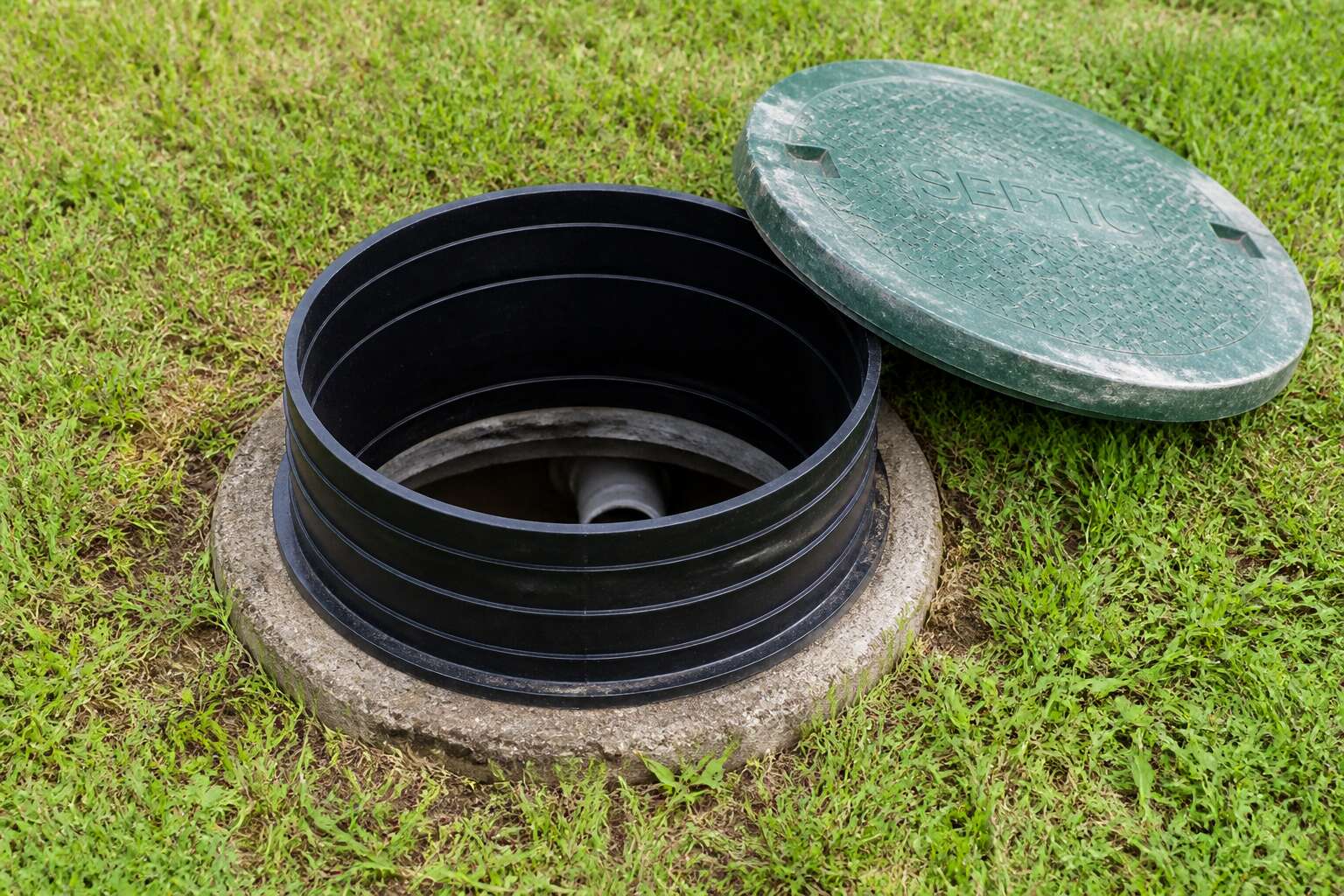
Understanding Septic Tank Risers
What Are Septic Tank Risers?
Owning a septic tank buried beneath your garden often means the access lid sits somewhere between inconvenient and completely inaccessible. When that lid is a foot or more below the surface, every inspection becomes a costly excavation project. Finding the entry point is a guessing game of poking the lawn with a metal rod. Eventually, someone digs a small crater just to lift the cover. This physical barrier is the core problem that septic tank risers solve.
A riser is essentially a vertical extension pipe that connects the tank’s original opening to the ground surface. The design is straightforward and functional, acting as a permanent tunnel to the lid. Once installed, you no longer need to dig to reach the septic tank. It provides immediate, ground-level access for cleaning, pumping, and general maintenance. For any homeowner, this simple alteration transforms a dreaded chore into a straightforward task.
The main components involved in a typical setup are:
– A durable, watertight ring that sits atop the tank opening.
– Stackable sections that adapt to the exact burial depth.
– A secure, ground-level lid that fits flush with the lawn.
In South Africa, where soil types vary from heavy clay to sandy ground, the stability of this installation matters. A properly fitted riser also prevents soil from seeping into the tank and keeps surface water out. It is an engineering solution for a common logistical headache. Whether the full system is mandatory is another matter, but understanding what the riser does clarifies the debate around how necessary it is.
Benefits of Installing Risers
Anyone who has watched a pump truck crew spend twenty minutes digging down to the lid understands the real price of an unrisen tank. Each visit turns into a labour bill, a torn-up lawn, and a slow afternoon. Riser installation removes that recurring cost entirely. You pay once, and every subsequent service call runs smoother.
The practical benefits extend beyond your wallet. A riser keeps groundwater and debris from entering the tank through a buried opening. It also lets the technician inspect the tank fully without guessing its exact location. For those wondering whether are septic tank risers required, the honest answer is that no national regulation enforces one. But consider the trade-off:
- An annual inspection takes minutes instead of hours.
- Pumping costs drop because there is less dig time.
- The tank lid stays visible and secure on any property.
Every South African homeowner eventually faces this decision as their tank ages. Fitting risers remains a voluntary choice, yet one that recovers its cost across a few service visits!
How Risers Work with Your System
Your septic tank is a sealed environment, and a riser is merely an extension of its doorway. It attaches to the manhole or access port, using gaskets and seals to preserve the tank’s airtight nature. Because the riser is open to the atmosphere, it equalizes pressure within the system. That matters when the tank is pumped, since rapid suction can otherwise pull a vacuum and damage internal baffles.
Risers also maintain the correct clearance for inlet and outlet pipes. They align with the existing flow path, so sewage does not pool at the base of the riser. A visible lid means you can monitor the tank’s water level during heavy rains, without guessing where the tank sits.
So when someone asks whether are septic tank risers required, the answer is no. But a riser works with your system’s hydraulics, not against them. It is a mechanical convenience, not a biological intervention.
Regulations and Code Requirements
Local Plumbing Codes
Local plumbing codes in South Africa are not uniform. The National Building Regulations and SANS 1042 provide the framework, but each municipality interprets them differently. This is where the question of are septic tank risers required becomes complicated.
Some municipalities insist on risers for any tank buried more than 400mm below grade. Others require them only when the tank sits under a driveway or parking area. The reasoning is straightforward: access for maintenance and inspection.
Local by-laws often demand:
- Visible access points at finished grade
- Lids that open without special tools
- Childproof locking mechanisms
These requirements protect both the owner and the drainage system. A buried tank without a riser becomes a hazard during emergencies. I have seen property owners face steep penalties for ignoring these rules. Are septic tank risers required in your area? Check with your municipal building control office before installation.
State and Federal Guidelines
At the national level, South Africa’s SANS 1042 specifications sidestep the question of whether risers are mandatory. The regulations focus on accessibility and safety, leaving municipalities to interpret the finer points. In practice, this means a tank buried deeper than 600mm should have a detectable access point, though enforcement varies with alarming unpredictability.
The National Building Regulations do offer some clarity for specific scenarios:
- Any tank beneath a vehicular area requires a load bearing riser
- Access lids must sit flush with the finished surface
- Inspection ports must remain visible without excavation
These guidelines do not answer are septic tank risers required in every instance. They simply establish a baseline for responsible installation. Property owners who assume the national rules settle the debate often find themselves at odds with their local building control office, which is an uncomfortable conversation to have while standing knee deep in a freshly dug hole.
Factors That Determine Compliance
The answer to are septic tank risers required begins with a tape measure and a soil report. The depth of the tank lid, measured from finished grade, is the first factor. If the lid sits deeper than 600 millimetres, most inspectors will require a riser to bring the access point closer to the surface. That depth threshold appears in various provincial guidelines, but enforcement depends on the municipality.
The structure’s location also matters. A septic tank under a driveway or a parking bay must handle vehicle loads, so a riser with a load bearing cover becomes a structural requirement, not a convenience. For tanks in soft, shifting soils, the riser prevents the access point from vanishing underground as the ground settles. Together, these conditions clarify are septic tank risers required in practice.
- Tank lid depth from finished surface
- Surface load rating for vehicular traffic
- Soil stability and settlement potential
- Approval conditions from the local authority
When a Permit Is Required
When a riser is planned, the permit process answers are septic tank risers required in a formal way. Municipal engineers review the application against SANS 1042 and local bylaws. A permit is mandatory when the riser extends above the natural grade or when the cover must support vehicle loads.
The application demands a site plan, a cross section of the tank, and specification sheets for every component. For a tank buried deeper than the approved depth, the municipality may require stamped engineering details. Inspectors verify that the riser does not create a trip hazard or interfere with drainage lines. The approval letter states are septic tank risers required for that property, binding the homeowner to those conditions.
Typical permit triggers:
- Riser height exceeding 300 millimetres above finish level
- Load bearing cover rated for heavy vehicles
- Any change to the tank inlet or outlet configuration
Practical Considerations for Homeowners
Cost vs. Value
South African homeowners rarely think about their septic tanks until something goes wrong. When that happens, the question of whether are septic tank risers required becomes a matter of cost versus convenience. A professional excavation can set you back thousands of rand, while a riser kit costs a fraction of that.
The real value shows up during every subsequent inspection. Without a riser, a technician must dig down to the lid each time, which adds labour and time to every service call. With a riser, the lid sits at ground level, turning a messy ordeal into a quick check. That is a luxury in South Africa!
Consider the expenses you might face:
- Digging equipment rental
- Labour for excavation and backfill
- Damage to your lawn or paving
These costs repeat with every pump out. So even if regulations vary by municipality, the financial argument alone makes risers a reasonable investment.
Maintenance Access and Ease
Ask a plumber in Johannesburg about the most common septic tank emergency and you will hear about a lost lid. The question of are septic tank risers required often surfaces only after grass hides the access point and a technician has spent an afternoon probing the ground with a steel rod.
Maintenance access is the quiet argument for risers. A tank buried a metre deep means every inspection becomes an excavation:
- Estimate the position of the buried lid
- Dig carefully to avoid damaging the tank
- Backfill and restore the ground afterwards
That process turns a twenty minute check into a half day job. From a homeowner’s perspective, ease means never guessing where the tank sits. A riser brings the access point to the surface, keeping the lid visible and reachable. You can lift it, look inside, and close it without calling anyone.
Soil and Climate Influences
Soil and climate do the real deciding. In the Highveld, expansive clay swells when wet and shrinks during dry spells. That movement pushes buried lids deeper or tilts them off line. Sandy coastal soils behave differently. They erode quickly, exposing tank edges to damage from mowers and livestock.
Rainfall patterns also matter. A sudden Johannesburg downpour can turn a well marked access point into a muddy guessing game. When the ground is saturated, digging becomes hazardous and expensive.
– Expansive clay: lids shift and sink
– Sandy soil: erosion exposes tank walls
– Heavy rain: access buried under mud
Are septic tank risers required? In regions with these conditions, the practical answer often becomes self evident.
Hiring a Professional vs. DIY
The decision to hire a professional or attempt a DIY riser installation rarely rests on cost alone. Your property’s soil conditions, the tank’s depth, and your own comfort with heavy lifting all enter the equation. A misaligned riser invites leaks, and a poorly compacted backfill can cause the whole assembly to settle unevenly. Are septic tank risers required in your situation? That answer often emerges once you assess the physical labour involved.
Professionals arrive with specialised excavation tools and laser levels, ensuring the riser meets the lid at a perfect angle. They also understand local groundwater patterns, which reduces the chance of flooding around the access point. DIY might work for a shallow tank on stable ground, but it demands a full day and a second pair of hands. Many homeowners find that the peace of mind from a sealed, warrantied installation outweighs the upfront savings.
Making the Right Decision
Weighing the Pros and Cons
Homeowners frequently ask whether are septic tank risers required, yet the answer rarely fits inside a single sentence. The decision involves balancing everyday practicality against the realities of your property and your habits. You must weigh the convenience of shallow access against the physical footprint a riser adds to your yard.
A few factors often tip the scale for South African homeowners:
– The depth of your current tank and how often you open it for inspections
– The seasonal weather patterns in your region and their effect on ground conditions
– Your preference for handling maintenance calls without manual digging
Each option carries distinct consequences. A riser streamlines future servicing, but it also commits you to maintaining an above-ground feature for years. Weighing these trade-offs honestly helps you move beyond the compliance question and toward what makes sense for your household.
Questions to Ask Your Inspector
Your inspector’s answer to whether are septic tank risers required often depends on what you ask, not what they volunteer. I once watched an inspector nod sagely at a tank buried under 600mm of clay, then mention the riser cost only after I’d signed the service agreement. So ask pointed questions.
- What does your own logbook show about this tank’s access history?
- Have you seen corrosion or structural damage near the lid on similar systems in this area?
- If we skip the riser, which maintenance task becomes a day-long excavation?
Those questions expose the difference between code compliance and sanity. The inspector’s hesitation after each one tells you more than any regulation ever will.
Long-Term System Health
Septic systems fail slowly, then suddenly. The day you watch a digger expose a buried lid is the day you remember every inch of soil you saved. Long-term health is not a function of the tank’s age but of your willingness to face it. I have seen systems that outlasted their owners because the access point was a deliberate decision, not an afterthought. The question of whether are septic tank risers required rarely gets answered by the inspector alone; it gets answered by the corrosion you cannot see until it is too late.
The human mind treats buried things as absent things. Risk assessment becomes a game of avoidance. Yet the system’s digestive process continues, and the maintenance window shrinks with every season. The installation of a riser becomes a contract with future you, converting a potential excavation into a routine inspection. The official answer might live in a code book, but the correct one lives in the silt and sludge of your own tank.
Alternatives to Traditional Risers
The debate over whether are septic tank risers required often misses a practical middle ground. Not every property needs a tall plastic riser standing above grade. Many South African homeowners choose flush-mounted covers that sit level with the lawn. Others prefer a shallow concrete collar with a recessed lid, which keeps the opening reachable without creating an obstacle for mowers.
Alternative access designs include:
– Level-mounted lids with rubber gaskets for watertight seals
– Shallow collar extensions that bring the opening closer to the surface
– Reinforced covers rated for occasional vehicle traffic
Each option changes how the tank is located and opened. The question of are septic tank risers required depends on how much excavation you accept. A buried tank with a flush lid still requires digging, but far less than a fully buried access point. The trade-off is surface visibility against convenience.



0 Comments