
Recognizing the Warning Signs
Slow Drains Throughout the House
A shower that drains at a glacial pace or a basin that holds water long after you leave the room might seem like minor annoyances. In a home serviced by an on-site sewage system, they are often the first audible clues that the waste level is rising. When the tank reaches capacity, the liquid rises above the outlet baffle, and solids travel further into the drainage field.
You rarely see a dramatic overflow at first. Instead, you notice a pattern:
- The kitchen sink gurgles after the washing machine empties.
- The guest bathroom toilet takes minutes to settle.
- Water pools around the floor drain after a single laundry load.
These multiple slow points across different fixtures point to a system-wide problem, not a single clogged pipe. The question of can septic tank be full becomes pressing when the drainage field starts rejecting water. That is the moment to investigate, because every slow drain is a signal you should not dismiss.
Sewage Odors Indoors and Outdoors
The smell of rotten eggs wafts up from the backyard after rain. That is hydrogen sulfide from a failing system. The question of can septic tank be full gets answered by your own nose before any inspection.
Odors indoors are harder to trace. They settle near floor drains or escape through the toilet base. If you catch whiff in the bathroom, the tank is likely over capacity. Waste gases push back up the pipes when liquid has no room to move.
Outdoors, the smell is sharper. It clings to the ground near the drain field. A full tank sends untreated effluent toward the surface. Moisture makes it worse. Check these spots:
– around the manhole cover
– near the drain field trench
– along the boundary wall
If that stench lingers, the tank is full and needs pumping right now!
Gurgling Sounds from Pipes
The plumbing gurgles before you reach the gate. It is a wet, unhappy noise. I hear it most often after a heavy laundry load, the sound rising from the bathroom floor. The question of can septic tank be full surfaces in audio form first. When the tank reaches capacity, liquid blocks the vent pipe. Air has nowhere to travel, so it pushes backwards, churning through the water traps.
Listen for these specific warnings!
- The toilet gulps and releases a deep burp after you flush.
- The kitchen sink emits a slow groan when the washing machine empties.
- The bath drain hiccups as the water level rises inside the pipe.
That gurgle is not a faulty pipe fitting. It is trapped air fighting rising effluent. So when you ask can septic tank be full, the gurgling answer is yes. The tank has no room for displaced air, and ignoring this rumble gives the pressure a weaker seam to escape through.
Lush Green Patches Over the Drain Field
The grass reveals the problem before anyone else does. Near the drain field, a patch of lawn glows an unnatural emerald green while the rest of the veld stays dry and yellow. I have seen this on many smallholdings.
That lush band of kikuyu marks the exact line where effluent has broken through the soil surface. When you wonder can septic tank be full, look at the grass. Overly verdant strips in winter, when neighbouring grass is dormant, signal a saturated absorption field.
Other clues sit beneath the surface:
- Soft, spongy ground that squelches underfoot
- A damp sheen on the soil without recent rain
- Grass that bolts upward, taller than the rest
The soil can no longer filter the wastewater. The question can septic tank be full becomes easier to answer when your lawn turns into a bog. The green patch marks the moment the liquid level has risen past the outlet pipe.
Understanding the Root Causes of an Overfilled System
Excessive Water Usage Patterns
A household’s daily rhythm can betray its own sanctuary. When washing machines churn through load after load and showers run long into the evening, the underground chamber receives more than it can digest. The question of can septic tank be full rarely announces itself with drama; it creeps in through routine.
Excessive water usage patterns are the quiet culprit. Every litre that enters the tank forces the solid layers upward, disturbing the delicate balance of decomposition. A typical family may not realise how quickly their habits accumulate.
- Several loads of laundry in one morning
- Baths drawn for every child each night
- A dripping tap ignored for weeks
Each contribution adds to the swelling burden, and believe me, the system feels every drop!
Flushing Non-Biodegradable Items
Many South African households flush items that were never meant to enter the wastewater stream. Disposable nappies, wet wipes, sanitary products, and cotton buds do not dissolve. They accumulate, forming dense mats that block pipes and consume the tank’s working volume.
This raises the pressing question of can septic tank be full from these items alone. Yes. The tank is not a rubbish bin. When non-biodegradable waste settles, the scum layer thickens and the liquid zone shrinks. The bacteria have nothing to digest.
- Baby wipes labelled as flushable
- Cigarette filters and dental floss
- Condoms and menstrual products
Each item occupies space reserved for organic breakdown. I have seen systems fail because a single nappy blocked the outlet tee. The result is a slow, silent backup that many homeowners only notice when the damage is done.
Heavy Rain and Groundwater Infiltration
Heavy rain transforms a septic tank into an unintended reservoir. Rainwater and groundwater infiltrate through cracked lids, loose inspection ports, and damaged pipes. The tank fills with clear water instead of waste, and the question of can septic tank be full from weather alone becomes painfully real.
Hydraulic overload happens when the surrounding water table rises above the drain field. Effluent cannot leach out, so it backs up. The liquid level climbs, the scum layer floats higher, and the outlet tee becomes useless. Bacteria are not the issue here; volume is. You could have the healthiest bacterial colony in the province and still watch your system drown.
Common entry points include:
- Cracked inspection ports
- Leaking pipe joints
- Soggy drain fields after prolonged storms
Each one sends litres of clean water straight into the tank. A heavy downpour can undo months of careful use in a single afternoon.
Infrequent Pumping Schedules
The question of can septic tank be full often starts with infrequent pumping. Solids settle into a dense sludge layer over years. That sludge consumes the working volume, leaving less space for liquid. I have seen tanks reach capacity without any sudden influx of waste.
Other root causes compound the issue. Tree roots invade pipe joints and block flow. An undersized tank struggles with daily demand. The bacterial colony cannot break down inorganic materials. Every factor pushes the system closer to overflow.
- Sludge depth exceeding one third of the tank
- Scum layer thickening beyond 75 millimetres
- Outlet baffles clogged with debris
These conditions turn a functional tank into a liability. Understanding why the tank fills, not simply when, prevents the next emergency!
Tree Root Intrusion into the Tank
Tree roots do not wait for an invitation. They detect the moisture and nitrogen seeping from your septic system and grow toward it relentlessly. Fine root hairs enter through pipe joints, lid seams, and tiny concrete fractures. Over time, those hairs thicken into dense mats that trap solids and block the outlet. Once the outlet is blocked, liquid has nowhere to move. This is how a can septic tank be full situation arises even when pumping is scheduled.
South African properties with mature trees face the highest risk. Root systems travel considerable distances underground and target the tank itself. Their pressure can shift the lid, which lets groundwater and silt wash inside.
- Roots reduce the working volume of the tank
- They clog the outlet baffle and cause backups
- Their growth widens cracks and weakens the structure
The sludge in a root-compromised tank resembles a wet, fibrous bog. No bacterial treatment fixes it.
Differentiating a Full Tank from a Clogged System
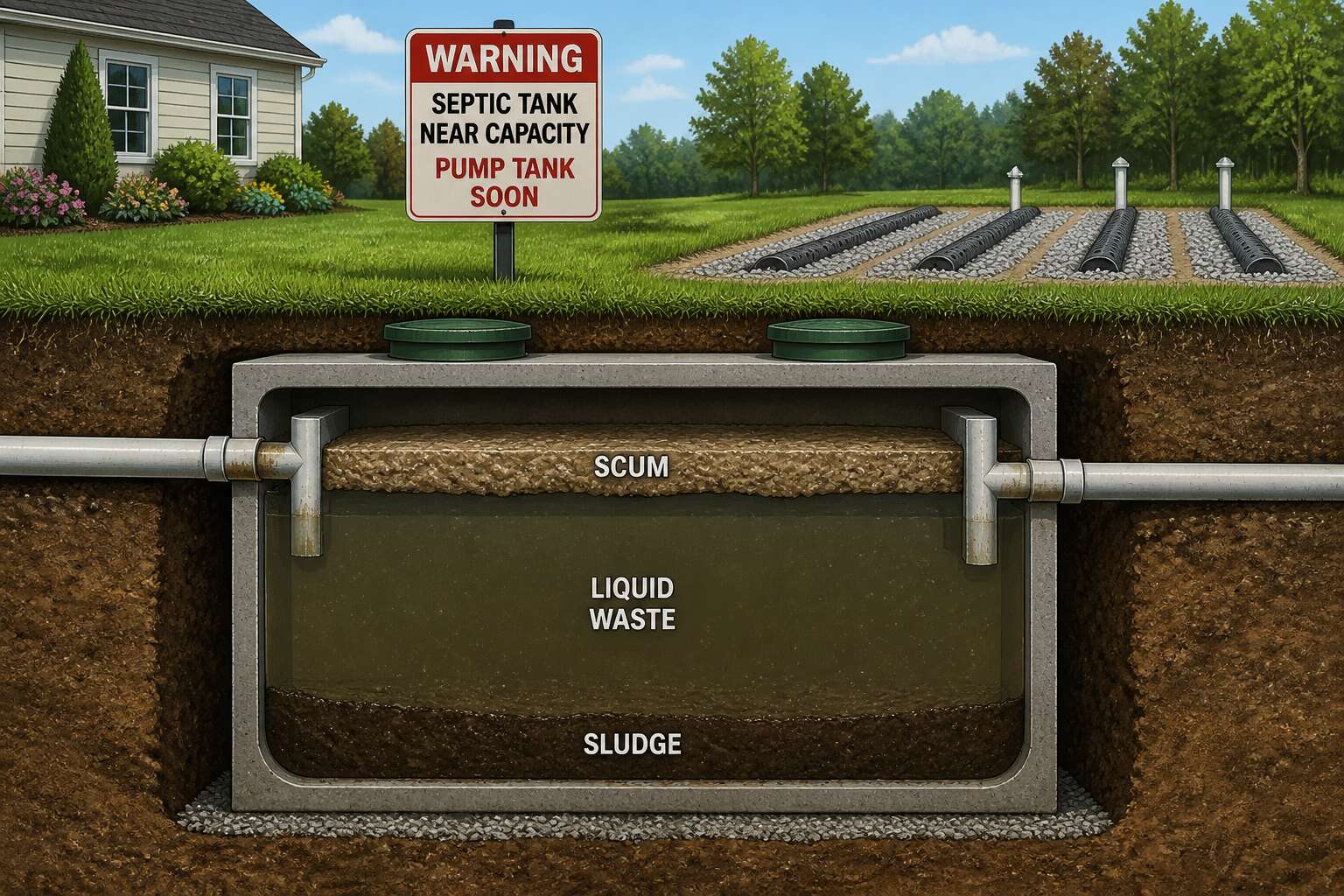
Septic Tank Layers Explained
Separating the tank’s condition from the pipe network’s condition answers the core issue of capacity. The tank holds three layers: scum, effluent, and sludge. As the tank fills, these layers shift and affect wastewater behavior.
A full tank pushes liquid above the outlet tee, sending solids into the drain field. A clogged system keeps the tank level normal while water backs up in pipes. Scum and sludge depth measurements provide a clear distinction.
- Full tank: scum layer thick, water level high
- Clogged outlet: scum layer normal, water level steady
South African homeowners often ask can septic tank be full when the surface looks stable. The answer lies in layer dynamics, where effluent clarity does not indicate emptiness.
Full Tank vs. Drain Field Failure
The question can septic tank be full often surfaces when fixtures drain slowly, yet the tank’s water level appears unchanged. A full tank raises the liquid line above the outlet tee, forcing solids toward the drain field. A failing drain field, however, keeps the tank level normal while wastewater backs up into the home.
Consider what happens after heavy rain or a long weekend of guests. A full tank produces sudden backups and gurgling when you flush. A clogged drain field produces steady, predictable pooling in the yard.
– Full tank: water rises quickly after each use
– Clogged system: water remains in fixtures for hours
The distinction matters because pumping a tank that is merely full does not restore a compromised drain field. South African homeowners should measure scum and sludge depths, not surface appearance, to answer can septic tank be full.
Diagnosing the Actual Source of the Problem
Beneath the quiet lawn, the truth hides in layers. A full tank does not announce itself. It shows through sluggish drains and a sour breath rising from the yard. The drain field, however, behaves differently. It floods your flowerbeds with a steady seep that ignores the rhythm of your household.
To answer whether can septic tank be full, you must lift the manhole and probe the sludge. A stick dipped into the darkness reveals the scum blanket. Measurements tell the story that surface appearances withhold.
One method to separate the two:
- Check the tank level after a night of no water use
- Compare it to the outlet pipe height
- Observe whether the yard pools only after heavy usage
When Professional Inspection Is Necessary
Only a professional can definitively answer whether can septic tank be full or the drain field has collapsed. A plumber will run a dye test and use a sewer camera to trace the path of water. This is crucial when symptoms overlap and simple measurements confuse the picture.
For instance, if your tank level stays high after a weekend away, that points to a full tank. But if the yard only soaks after rain, the leach lines may be blocked. Without this expertise, homeowners often misdiagnose the issue and pay for unnecessary pumping. Call in a specialist when the problem persists or the sludge depth exceeds the outlet pipe height.
Effective Solutions for an Overfilled Septic Tank
Immediate Pumping and Tank Cleaning
When raw sewage sits above the inlet pipe, you ask can septic tank be full. The remedy begins with rapid intervention. A licensed pumper removes the liquid, scum, and sludge through a vacuum hose. This relieves pressure on the tank walls and prevents wastewater from flowing back into your home. I have watched homeowners delay this call for weeks, mistaking the problem for a simple blockage.
Once pumping finishes, a thorough tank cleaning is essential. The pumper sprays down the interior surfaces and removes remaining solids clinging to the walls. This step also exposes the condition of the inlet and outlet baffles. A cracked baffle causes future overflows, so the cleaning doubles as a diagnostic moment.
- Measuring the scum layer thickness
- Vacuuming out all contents
- Flushing the tank and inspecting the fixtures
Skipping the cleaning leaves a thin layer of sludge that quickly recontaminates the tank, so the question of can septic tank be full returns within weeks.
Adjusting Household Water Consumption
When the tank level creeps upward, the simplest lever is your own water use. Spreading laundry across the week instead of doing everything on Monday reduces hydraulic shock. A leaking toilet flapper can send hundreds of litres into the tank without anyone noticing.
Someone always asks, can septic tank be full if we barely use water? Yes, but managing inflow still matters. Households that succeed often capture shower runoff for the garden, run dishwashers only on full loads, and check for silent leaks monthly. These choices buy time before pumping and keep the drain field from drowning.
Repairing or Replacing the Drain Field
After pumping, the real work starts. If the drain field remains saturated, the soil has reached its limits. A failed drain field cannot recover on its own. You are facing either targeted repair or complete replacement.
Repair works when damage is isolated. Crews excavate blocked sections, replace crushed pipe, and backfill with fresh stone. Replacement becomes necessary when biomat has sealed the entire absorption area. I have watched homeowners pay twice because the cheapest quote skipped the soil test.
Signs that replacement outranks repair:
- Effluent surfacing above the trench line
- Spongy soil that holds water for days
- Trenches failing one after another
So, can septic tank be full after a new drain field? Only if the installer undersizes the trenches or ignores percolation results. A proper job accounts for geotextile fabric and pressure washing the tank before the system goes back online.
Evaluating the Use of Septic Additives
With the system back online, the next decision is what belongs inside the tank. Homeowners often wonder can septic tank be full even after corrective work. The answer lies in the balance of solids and liquids. A tank reaches capacity when sludge and scum consume the usable volume. Additives cannot change that physical reality.
Commercial products claim otherwise. Enzyme treatments digest fats and proteins. Bacterial cultures replenish microbial populations. Some additives genuinely maintain a healthy environment. Others produce foam and false confidence. The question can septic tank be full after pumping is best answered by inspecting the tank, not by pouring in a bottle.
- Biological additives support digestion when used consistently
- Chemical degreasers may clear a clogged pipe but risk killing bacteria
- Monthly enzyme doses reduce sludge buildup between pumpings
No additive replaces the pump truck. An overfilled tank is a mechanical problem with a mechanical solution. Additives are maintenance tools, not rescue devices.
Preventative Measures to Avoid Future Fill-Ups
Scheduling Regular Inspections and Pumping
Regular inspections are the quiet guardrails that keep your system honest. Instead of waiting for warning signs, a technician measures the actual sludge and scum layers inside the tank. That data answers the question of can septic tank be full before it ever becomes a household emergency. Without this step, you are simply guessing at a problem that likes to hide.
Pumping frequency depends on more than a calendar. These factors shift the schedule:
– Number of permanent residents
– Total wastewater volume, including washing machines and baths
– Tank size in litres
– Use of a food waste disposal unit
Most residential tanks need pumping every three to five years, but an inspection can adjust that window. For South African homes with high seasonal rainfall, the soil around the tank stays wetter, which changes how quickly solids accumulate. A structured plan, with inspections at least every twelve months, lets you stay ahead of the rising waste level. You never reach the point where the entire system simply gives up.
Adopting Proper Waste Disposal Practices
Prevention begins with what you allow down the drain. The tank is a biological system, and every wash cycle affects the bacteria that break down solids. When the load is toxic, the breakdown slows and the level climbs. The question of can septic tank be full answers itself after years of poor disposal habits.
Scrape plates into the bin before rinsing. Use a strainer in the sink to catch fragments. Pour cooking oils into a jar, not the drain. These rituals stop the scum layer from forming a crust that resists pumping.
- Collect kitchen grease in a sealed container for the rubbish bin.
- Bin food scraps before plates reach the water.
- Keep corrosive drain cleaners out of the system.
Proper disposal reduces the volume of solids entering the tank. When the tank receives less to process, the worry that can septic tank be full recedes. The next inspection becomes a formality, not a rescue mission.
Water Conservation Tips for Households
One person sends upwards of 200 litres down the drain every day, and most of it passes through the septic tank. Water conservation matters as much as waste disposal, because volume decides how fast solids settle. Excessive water use keeps the liquid level high. In my years around rural homes, I have seen tanks fail for no other reason than constant, small leaks. It adds up fast! That is when people start asking can septic tank be full.
- Spread laundry across the week, not one Saturday
- Run the washing machine only when full
- Fix dripping taps, since leaks waste litres overnight
- Install low-flow shower heads and keep showers under five minutes
- Use the dishwasher instead of hand washing
Every litre saved is a litre the tank never processes. Steady water use keeps the level stable, and the worry over can septic tank be full fades.
Landscaping Considerations for the Drain Field
Preventing future fill-ups starts with understanding the tank’s limits. The question of can septic tank be full should have a simple answer: no, if you stay ahead of it. Schedule a professional inspection after every two winters. Check the distribution box for blockages. Most importantly, balance daily water use so the tank receives steady, manageable flows.
Landscaping for the drain field requires deliberate choices:
- Plant only shallow-rooted ground cover
- Keep trees at least ten meters away
- Do not pave or compact the soil above the field
- Direct roof runoff and downspouts elsewhere
Proper layout ensures the soil can absorb effluent efficiently. When the drain field breathes, the tank never reaches that critical point. So the next time you wonder can septic tank be full, inspect the yard first.
Seasonal Maintenance and Weather Precautions
Winter rain in the Western Cape or summer thunderstorms in Gauteng can overwhelm a system already near capacity. The real question, can septic tank be full, often surfaces after a downpour. Waterlogged soil has nowhere to send effluent, so the tank fills faster than normal.
- Inspect the riser lids for cracks or loose seals
- Clear gutters and downspouts that drain toward the tank
- Monitor the level gauge after heavy rain
Wait a few days after a storm before running heavy loads. If you notice standing water near the tank, that is a warning. Preventative measures like these keep the system balanced, meaning you never have to ask can septic tank be full because you have already managed the risk. Seasonal maintenance takes fifteen minutes, but it saves you from a messy emergency.



0 Comments