
Identifying the Warning Signs
Slow Drains Throughout the House
A slow drain is the earliest sign of a failing system. In South Africa, where storms and old pipes are common, the first clue that your septic tank is backing up shows up in the lowest basin or shower. This is a mechanical warning, not a random clog, and ignoring it costs you! You might hear gurgling after a flush. Water levels in the toilet may shift. These signs point to solids exceeding your tank’s capacity.
- Kitchen sink draining in spurts
- Bathtub holding water after a short soak
- Multiple drains clogging together
Each slow drain worsens sludge accumulation. I have seen homeowners wait too long, then face a full backup. Address roots or a collapsed pipe before the septic tank is backing up completely.
Unpleasant Sewage Odors
A faint, sulfurous odor can be the only announcement of impending failure. This smell, resembling rotten eggs, does not belong in your home or garden. It escapes through cracks, vents, or the ground when the system is overwhelmed. In South Africa, summer thunderstorms often trigger these emissions by saturating the soil. A septic tank is backing up when this odor lingers for more than a day.
Inspect these locations for the source:
– The soil above the drain field
– The bathroom floor drain
– The yard near the inspection lid
Persistent stench indicates the tank’s capacity is breached. Masking it with cleaners hides the evidence. The smell is a structural verdict. Every day you delay, the pressure rises.
Gurgling Sounds in Pipes
Another acoustic clue arrives before the visible mess does. Gurgling sounds in pipes are air bubbles struggling to escape trapped water. This happens when the plumbing system loses its normal pressure balance. The water in your drains is fighting for space with gas that has no place to go. When you flush the toilet and hear a glug from the shower drain, pay attention. The system is speaking a clear language of displacement.
The noise often appears at the lowest point in the house. This is where the main line meets the septic system. The air is being pushed back toward you instead of venting through the tank. It is a warning that the septic tank is backing up. The waste has risen to a level where the gases can no longer move along their intended path.
Listen for these sounds in regular intervals:
– The toilet bowl after a flush
– The kitchen sink while the washing machine drains
– The bathtub when the toilet is flushed
The gurgle is not harmless pipe chatter. It is the byproduct of a blocked journey, a signal that the water and waste have nowhere to travel. Every gurgle means the tank is approaching a state of failure. The sounds will grow louder as the system deteriorates, moving from a faint murmur to a distinct struggle.
Lush Green Patches Over the Drain Field
Nothing green in nature should look quite so perfect. Over the drain field, the grass grows with a fervour that stands apart from the surrounding veld. I have seen this pattern on too many properties. This unnatural emerald draws the eye, but it signals decay below. The luxurious patch is the ground saturated with waste water. When the septic tank is backing up, liquid effluent forces itself into the topsoil, feeding the roots with nitrogen and phosphate.
The exact pattern matters:
– A vivid strip tracing the buried pipes
– A spongy, wet area underfoot even after dry days
– Grass that stays green through winter
Each marker points to the same failure. The soil has reached its absorption limit. The system is failing, and the surface is where the waste settles.
Sewage Backup in Bathtubs or Toilets
Your bathtub and toilet reveal the problem first. If you notice the toilet bowl water rising and falling on its own, do not dismiss it as a pipe blockage. The septic tank is backing up.
Watch for these peculiarities:
- Water level in the toilet bowl fluctuates without flushing.
- Bathtub water leaves a gritty residue after draining.
- Toilet paper floats rather than breaking down.
These signs are the septic system’s indicators. The liquid seeks the easiest escape route, and your bathroom fixtures become the unfortunate vents.
Common Reasons for a Septic Backup
Clogged Pipes Blocking the Flow
Every day, a single obstructed pipe can render an entire drainage system nonfunctional. The underlying cause of a backup is often a physical clog in the conveyance lines, not the tank itself. Cooking grease cools and solidifies, capturing hair and soap scum into a dense, sticky mass. This narrowing pathway forces wastewater to slow, allowing solids to settle and seal the line.
Tree roots infiltrate cracked joints, forming a web that traps debris. A misaligned pipe creates a low spot where silt collects.
Common obstructions include:
- Sanitary products and wipes
- Fats, oils, and grease
- Mineral scale
The backup you see is only the final event. When your septic tank is backing up, understanding the composition of these clogs helps you respond correctly.
Overfilled Septic Tank Due to Neglect
Many South African homeowners treat pumping as a once-a-decade event, if they remember it at all. That is why a septic tank is backing up in so many suburbs. The tank fills with a dense sludge layer that never leaves.
When you skip regular desludging, solids compact at the bottom. The tank loses its capacity to separate waste. Effluent rushes into the drain field, saturating the soil. The backup arrives at the worst possible time.
Neglect comes in several forms:
- Never booking a desludging service
- Allowing heavy vehicles to park over the tank
- Ignoring the water level in the inspection pipe
I have watched this happen. A full tank creates a constant hydraulic load. The tank becomes a holding vessel, not a treatment unit. Eventually, the water from your shower pushes the backlog straight back up your floor waste.
Tree Root Intrusion into the System
Tree roots are relentless. They find the smallest crack in a septic system. In South African suburbs, many tanks sit near old oaks or invasive alien species. The roots seek moisture and nutrients. They penetrate tank walls and drain pipes.
Once inside, they form dense mats. These mats catch debris. The flow slows. The septic tank is backing up because the outlet is blocked. Not because of neglect. The tank may have been pumped months ago.
Root intrusion signals differ from other blockages:
- Intermittent backups. The toilet flushes fine at night.
- Backups after heavy rain.
- A dry drain field despite normal use.
Roots are a structural problem. Pumping does not solve it. The pipes need inspection. Mechanical or chemical removal works temporarily. If the tank walls are cracked, the roots return. The septic tank is backing up again within weeks. Choosing the right planting locations prevents the problem.
Damaged or Collapsed Drain Field
The collapse of a drain field is rarely sudden. It happens slowly, underground, and by the time wastewater rises to the surface, the damage is already advanced. The septic tank is backing up because the liquid has no exit. The soil has lost its ability to absorb.
Heavy vehicles can crush the perforated pipes. Construction equipment compacts the soil until the pores close. In South African clay soils, compaction is a common problem. Water then surfaces on the lawn or flows back through the plumbing.
Warning signs of a damaged drain field:
- Standing water with a foul smell
- Wastewater surfacing far from the tank
- Ground settling or sinkholes above the pipes
A collapsed field does not recover on its own. The septic tank is backing up every time someone flushes. The pipes and gravel are excavated. The soil gets tested and rebuilt before the system can function again.
Flushing Non-Biodegradable Items
The flush button is often a gateway for trouble. Non-biodegradable items like wet wipes, nappy liners, and cotton buds do not dissolve in the tank. They find their way past the inlet baffle and start forming a solid mass.
Common culprits include:
- Synthetic wipes and baby wipes
- Sanitary products and condoms
- Dental floss and cigarette butts
These materials create a dense mat. Anaerobic bacteria cannot process them. They sit in the tank, reducing the active volume. The effluent has to travel through this sludge, slowing everything down. Eventually, the outflow pipe gets overwhelmed. That is why your septic tank is backing up long before a scheduled pump-out. The tank is full of items that simply refuse to break down.
Excessive Water Usage Overloading the System
Water rushes through your home in volumes the tank never expected. Every shower, load of laundry, and toilet flush sends liquid into the tank at a rate bacteria cannot keep up with. The tank’s job is to hold effluent long enough for solids to settle and liquids to flow out. When you flood it, that separation breaks down. Solids get pushed toward the outlet pipe, and your septic tank is backing up as a direct result.
Consider how many appliances run simultaneously in a single morning:
- Two showers before work
- A washing machine cycling through loads
- The dishwasher running after breakfast
That spike in water volume overwhelms the system’s capacity. The tank fills faster than it can drain, and the backup appears without warning.
Immediate Actions to Take
Stop All Water Usage Right Away
The moment you suspect your septic tank is backing up, the most rational response is not to investigate. It is to stop every source of water in your home, immediately. A single flush or a running tap adds pressure to an already failing system. That pressure drives waste upward, into your fixtures and your living space. I have seen homeowners waste precious minutes inspecting the drain field or the tank lid while water continues to flow. This is a mistake that worsens the situation.
Cease all water usage without exception. That means no showers, no dishwasher, no laundry, and no rinsing dishes. Here is what you must halt right away:
- Flushing toilets
- Running sinks or taps
- Using washing machines or dishwashers
- Filling bathtubs or pools
Every litre you add now is another burden. Give the tank a chance to settle. Only then can you assess the actual cause of the backup.
Avoid Using Chemical Drain Cleaners
A bottle of chemical drain cleaner seems convenient, but it is a mistake. When your septic tank is backing up, harsh solvents only damage the system. They eat away at pipes and kill the bacteria that process waste. I have witnessed weakened plumbing from such products.
Skip the gels, foams, and crystal powders entirely. These cleaners do not address the root cause.
- Do not pour bleach or degreasers down drains.
- Do not mix chemical cleaners, as toxic fumes may form.
Physical methods like plunging or snaking clear blockages without harming the tank. The underlying clog requires mechanical force, not a chemical reaction. I have seen many homeowners worsen a backup by reaching for a bottle first.
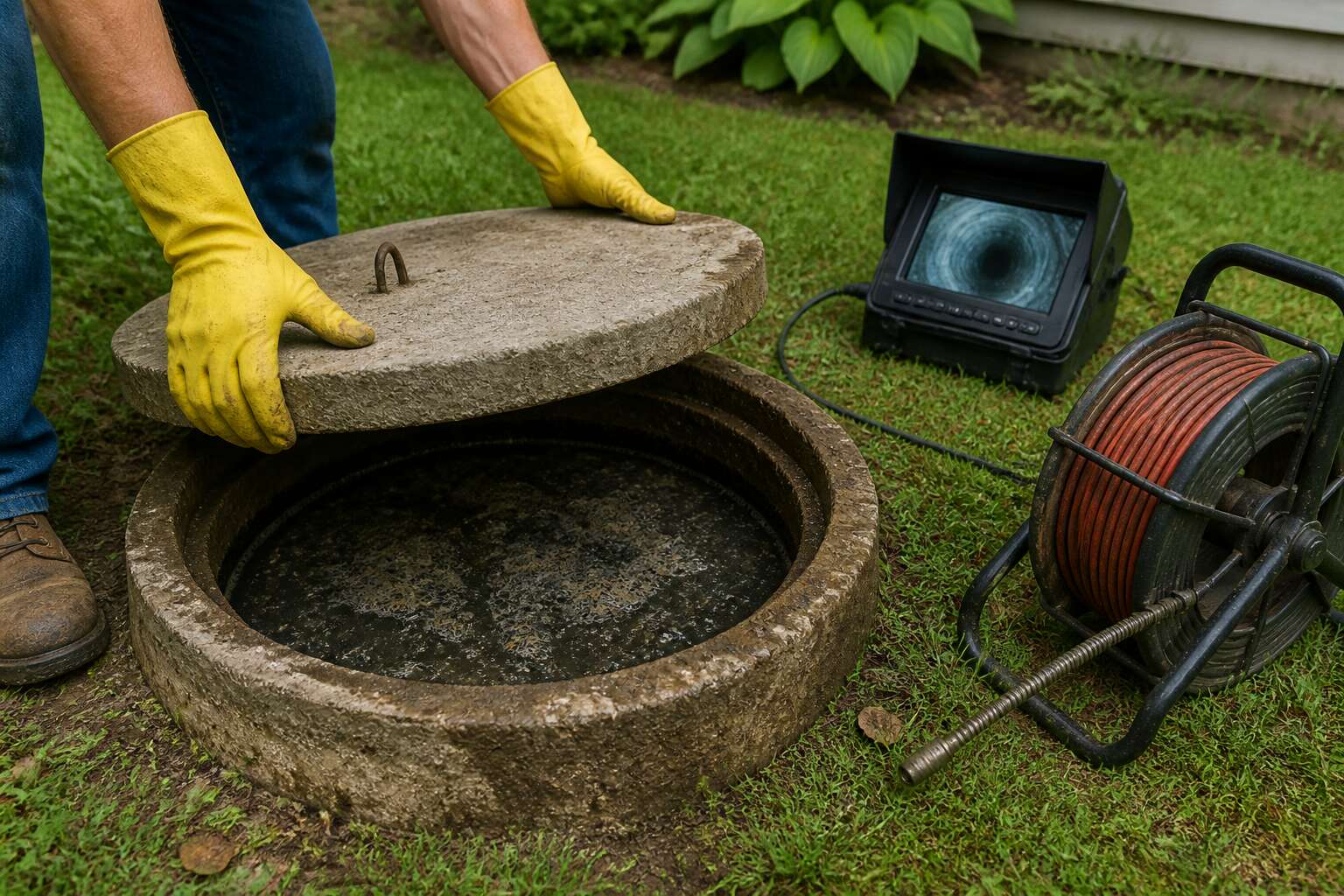
Inspect the Septic Tank Access Opening
When the septic tank is backing up, your first instinct might be to panic. Instead, locate the access opening. That concrete or plastic lid in your garden has been waiting for this moment. It hides the evidence.
Use your eyes. I once lifted a lid to find a family of frogs and a tennis ball, none of which belonged there. Check the hatch for cracks, damage, or signs of movement. Look for pooling water nearby. That tells you the level inside is too high.
- Check that the lid fits securely
- Look for debris blocking the opening
- Note any unusual moisture around the rim
Inspection beats guessing. Open the access point carefully and observe what is there. Gather facts, not speculation.
Do Not Dig Near the Septic System
When the septic tank is backing up, the earth itself becomes a liar. A shovel in your hand feels like control, but the soil hides the true geometry of the system. Digging near the drain field risks puncturing a line already under pressure, or worse, collapsing a wall that holds effluent in its grave.
Instead, resist that primal urge. Mark the ground with stakes, but do not break it. Call a professional who knows the local clay and rock of South Africa’s terrain. The immediate actions are simple and safe:
- Photograph the area before any work begins
- Keep children and animals away from the suspected zone
- Record the last pumping date to share with the technician
The septic tank is backing up because something upstream has failed. Digging only adds a new failure. Let the ground hold its secret until the right hands arrive, for the answer lies not in your blade, but in the patience of those who read the hidden water.
Contact a Licensed Septic Professional
When the septic tank is backing up, the window for safe action narrows quickly. The first and only hands that should touch the system belong to a licensed professional. They interpret the symptoms: the slow drains, the gurgling pipes, the pressure building in ways you cannot see.
Before you make the call, gather key details. A technician will need to know the last pumping date, the number of occupants, and any recent heavy rains. Do not attempt a DIY fix!
- The last service date
- Any past repairs or inspections
- When you first noticed the backup
A licensed professional uses a camera to trace the line and locate the failure. That camera reveals the truth that digging cannot. Contact them now, and let the septic tank is backing up become a story already told.
Preventative Maintenance Tips
Schedule Regular Pumping and Inspection
Prevention is the only thing standing between your property and a septic tank is backing up. I have watched homeowners ignore their tanks for years, only to face costly repairs that could have been avoided. A simple schedule changes that outcome. Pumping every three to five years removes the accumulated sludge and scum that silently reduce your tank’s capacity. Inspections go deeper. A qualified technician will assess the structural soundness of the tank, the condition of the baffles, and the absorption capacity of your drain field.
Typical inspection points include:
– Scum and sludge layer thickness
– Baffle integrity
– Drain field saturation
Scheduling these checks during South Africa’s drier months gives you a workable window to fix small issues before seasonal rains turn them into emergencies.
Practice Water Conservation in the Home
Your septic system has a fixed capacity. It is a biological chamber, not a municipal sewer. Treat it as the latter, and you will soon face a septic tank is backing up emergency. Water conservation is your smartest move.
Every litre you save reduces the load on your pipes, tank, and drain field. Simple changes produce meaningful results.
- Fix that dripping tap. A single leak wastes 50 litres a day.
- Take shorter showers, not longer ones.
- Run your dishwasher and washing machine only when full.
- Use a bucket to catch cold water while waiting for hot water.
Space out your laundry across the week. Avoid doing everything on Monday morning. Your tank needs time to process what you send. Ignore this, and you will soon deal with a septic tank is backing up situation that ruins your weekend.
Dispose of Waste Properly and Avoid Grease
South African kitchens pour an estimated 20 million litres of cooking oil down the drain each year. As this oil cools, it hardens into a waxy mass that coats pipe walls and settles in the tank, choking the bacterial colony that breaks down waste.
Proper waste disposal directly prevents a septic tank is backing up situation. Keeping the sink clear of everything that isn’t water or human waste is critical. Food scraps, coffee grounds, and fibrous materials belong in the bin, not the plumbing.
- Catch solids with a sink strainer.
- Pour fats into a jar and discard it with general waste.
- Scrape plates into the bin before rinsing.
Ignoring these preventative measures guarantees that sludge will build up until a septic tank is backing up emergency forces you to call for help with costly repairs.
Protect the Drain Field from Heavy Machinery
The drain field is not a parking lot, though you wouldn’t know it from how some South African homeowners treat it. Park a bakkie on that ground and the soil compacts, pipes crush, and the entire treatment area fails. This is how a septic tank is backing up starts, not with a dramatic event, but with tyres pressing down on buried infrastructure.
Keep heavy machinery and vehicles away from the drain field. Mark the area clearly so contractors, delivery drivers, and weekend DIY enthusiasts know where the lines run. Fences or bollards work as permanent reminders.
Here is what destroys drain fields faster than anything else:
– Parking cars or tractors on the field
– Storing heavy building materials on the ground
– Driving over the area during construction or landscaping
Each one compresses the soil, suffocating the aerobic bacteria that digest effluent. Once that happens, expect surface pooling, foul odours, and a septic tank is backing up into your home. Protect the ground above your system, and it will protect everything below it.
Use Septic-Safe Cleaning Products
Your septic tank is backing up because you cleaned the bathroom with bleach. Harsh chemicals kill the bacteria that digest waste, and they don’t care about your fresh lemon scent. Switch to septic-safe cleaning products. Look for biodegradable labels or stick to vinegar and baking soda. Skip these common offenders:
- Chlorine bleach
- Antibacterial soaps
- Drain openers
Read every label before purchase. One vigorous scrub with the wrong product can poison the entire tank. The system backs up when the microbial colony dies, not when a surface shines. Cleaners that let the bugs live keep the whole arrangement running smoothly.
Maintain a Healthy Bacterial Balance in the Tank
Your septic tank is backing up when the bacterial colony inside it collapses. Those microbes digest the solids that enter the system. Without them, waste accumulates and the tank fills beyond capacity.
Feed the bacteria a consistent diet. Flush only human waste and toilet paper. Add a commercial bacterial treatment every few months, especially if the household runs heavy laundry loads or hosts frequent guests. A stable population keeps everything moving.
- Use septic-safe cleaning products only
- Avoid pouring fats or oils down drains
- Skip garbage disposal use where possible
Track what enters the tank. The ecosystem loses its balance before the system fails. Protect the colony and the system keeps working.
Professional Repair Solutions
Hydro Jetting to Clear Stubborn Blockages
Every clog has a breaking point, and for most septic systems, that point yields to hydro jetting. When a septic tank is backing up, this professional repair solution targets the hardened debris that snakes and rods cannot dislodge.
Technicians insert a nozzle connected to a high pressure hose. The water stream, directed through rotating jets, scours the entire circumference of the pipe. This action removes layers of mineral scale and organic waste that reduce flow over time. Unlike chemical treatments, hydro jetting leaves no hazardous residue behind in your property’s drainage network.
The procedure suits properties with persistent blockages. Typical obstructions that respond well include:
- Dense sediment packed into pipe joints
- Stubborn biofilm that coats interior surfaces
- Foreign objects lodged in the sewer line
Each pass clears a path that restores normal drainage capacity, giving the septic system a clean slate for years of trouble free operation.
Complete Tank Pumping and Cleaning
When your septic tank is backing up, the professional repair solution is a complete pump and clean. I have watched this process, and it involves less magic and more grunt work than you might imagine. Technicians bring a vacuum truck and heavy hoses.
They open the manhole cover and pump out all liquid and solid waste. Then they scrape the interior walls. After that, they rinse the tank and inspect the baffles and pipe connections. A typical service includes these elements.
- Complete evacuation of the tank contents
- High pressure washing of the interior surfaces
- Inspection of baffles and outlet pipes
That inspection is what separates a lasting fix from a costly repeat visit.
Root Removal and Barrier Installation
Roots are a relentless enemy when a septic tank is backing up! They enter through hairline fractures in pipes and follow the nutrient rich flow. A professional repair solution starts with mechanical root removal, using a rotating cutter to clear the line completely. But cutting alone is only temporary.
Barrier installation is what follows. Technicians place a chemical or physical barrier along the trench to deflect new growth. The process includes:
- Root locating with camera inspection
- Cutting and vacuuming all root mass
- Installing a root barrier membrane
This two part repair protects the system for years. In South Africa, summer rains accelerate root growth, so this service matters. If your septic tank is backing up repeatedly after pumping, request root removal and barrier installation before the drain field suffers.
Septic Tank Repair or Replacement
Some septic failures originate within the tank structure itself. When a septic tank is backing up despite clear lines and a freshly pumped tank, the concrete may be cracking or the steel corroding. Groundwater seeps in through these openings, and effluent leaks out into the surrounding soil.
A licensed technician performs a camera inspection to assess the damage. Small fractures can be repaired with structural liners. Significant deterioration leaves no choice but to excavate and replace the entire tank. The decision rests on the tank’s age, its material, and the severity of the damage.
Replacement becomes necessary when:
– Tank walls show visible collapse
– The lid sinks or shifts from its original position
– Repairs fail repeatedly within a short period
South African soil movement and seasonal rainfall place heavy demands on tank walls. Addressing structural issues early prevents the drain field from failing alongside the tank.
Drain Field Restoration or Redesign
When the drain field fails, the soil can no longer absorb effluent. The ground becomes saturated, and the septic tank is backing up even after pumping and tank repairs. A licensed professional will test the soil and measure the water table before recommending restoration or a complete redesign.
Restoration involves trenching the existing field, replacing gravel, and installing new perforated pipes. Redesign becomes necessary when the original layout no longer suits the property. The technician may propose a raised bed or mound system to overcome shallow bedrock or high groundwater.
Option choices depend on lot size, soil type, and local regulations. The professional will also examine the distribution box to ensure even flow across all trenches. Matching the design to site conditions prevents a repeat failure. Ignoring the issue means the septic tank is backing up again within months.



0 Comments